

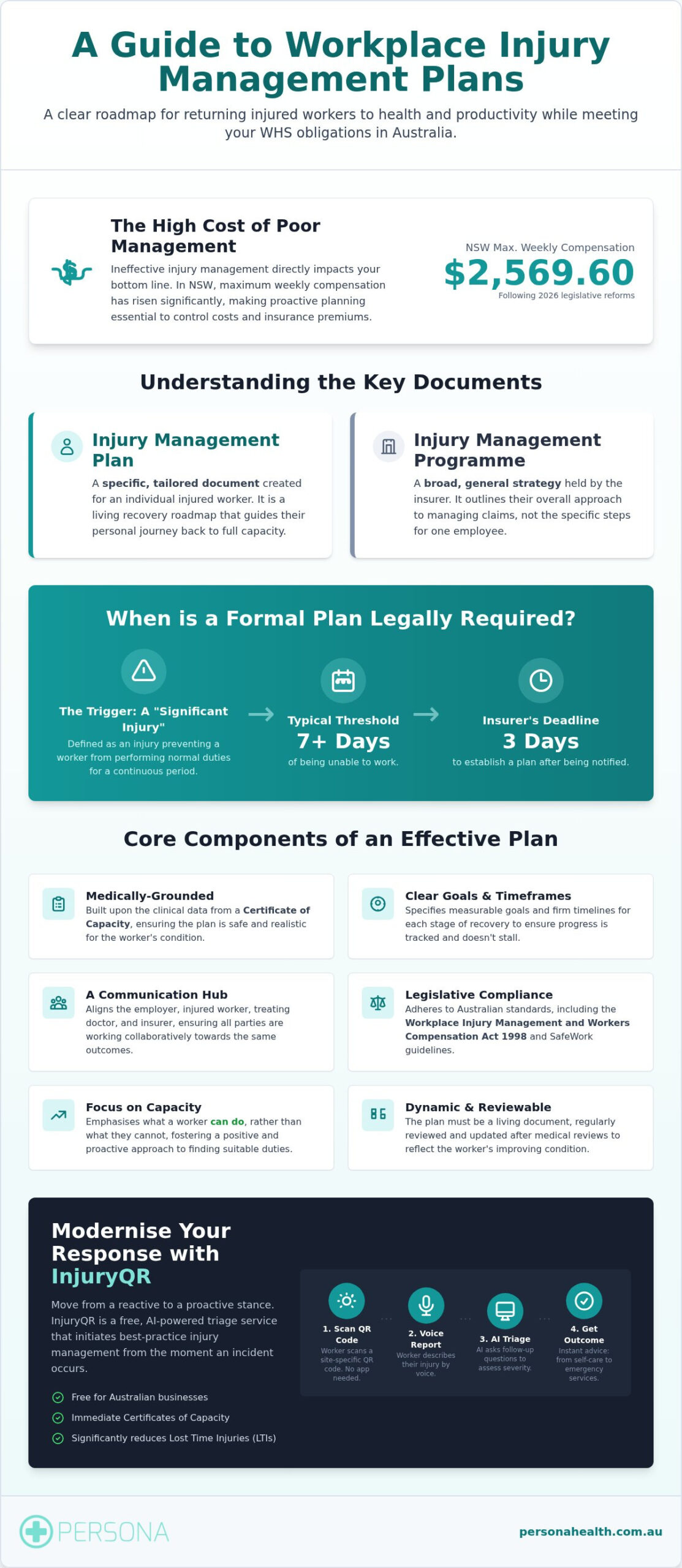
A workplace injury management plan is far more than a compliance checkbox; it is the primary roadmap for returning an injured worker to health and productivity while safeguarding your business from escalating costs. With the maximum weekly compensation in New South Wales recently rising to $2,569.60 following the 2026 legislative reforms, the financial stakes of a poorly managed claim have never been higher. We understand that navigating state-specific regulations and coordinating between various medical providers can feel overwhelming, often leaving employers stuck between clinical requirements and operational needs.
You want to do right by your employees, yet the anxiety of rising insurance premiums and lost time injuries often creates a sense of deep uncertainty. This guide provides a clear, actionable path to developing an effective workplace injury management plan that ensures you meet your legal obligations under current WHS legislation. We will show you how Persona Health’s employer-focused approach, supported by our clinics in Sydney and Melbourne, can streamline the recovery journey. You will learn how to integrate modern tools like InjuryQR to move from a reactive stance to a proactive one, achieving faster return-to-work outcomes and significantly reduced workplace disruption.
Key Takeaways
- Understand that a workplace injury management plan is a tailored recovery roadmap designed to support a safe and durable return to work for your employees.
- Identify the core components of a compliant plan, including the necessity of setting measurable goals and clear timeframes for every stage of the recovery process.
- Ensure your business adheres to Australian legislative requirements by following the standards set by SafeWork Australia and relevant state-specific acts.
- Discover how immediate action during the “Golden Hour” after an incident can significantly reduce lost time and improve long-term health outcomes.
- Learn how partnering with an employer-focused occupational health provider like Persona Health ensures seamless communication between medical teams and your business.
What is a Workplace Injury Management Plan?
A workplace injury management plan is a bespoke document created specifically for an injured worker once a significant claim is made. It isn’t just a generic set of rules; it’s a personal recovery path designed to guide an individual from the point of injury back to their full capacity. Many employers often confuse this document with the overarching Injury Management Program. It’s vital to understand the difference. The “Program” is the broad strategy held by the insurer that covers their general approach to claims, whereas the “Plan” is the specific, living document that applies to your individual employee’s unique circumstances and health needs.
Under the Workplace Injury Management and Workers Compensation Act 1998, establishing this plan is a legal necessity for significant injuries. It ensures that the recovery process isn’t left to chance or stalled by administrative delays. By formalising the steps, you protect both the worker’s long-term wellbeing and your business’s operational stability. At Persona Health, we view the workplace injury management plan as a collaborative agreement that aligns medical care with workplace possibilities, ensuring everyone is moving in the same direction.
To better understand the importance of safety and the consequences of workplace incidents, watch this helpful video:
The Purpose of an Individual Plan
This document acts as the central hub for communication, bringing together the employer, the injured worker, the treating doctor, and the insurer. Without a clear plan, these parties often work in silos, which can lead to recovery delays and unnecessary friction. The plan outlines specific treatment goals and realistic rehabilitation milestones, ensuring all parties are working toward the same timeline. It sits within the broader Workers’ compensation framework, providing a structured way to measure progress. We focus on identifying what a worker can do, rather than just what they can’t, which is essential for a durable return to work.
When is an Injury Management Plan Required?
Not every minor incident requires a full formal plan, but one is triggered as soon as a “significant injury” occurs. In most Australian jurisdictions, including NSW and Victoria, this is defined as an injury where a worker is unable to perform their normal duties for a continuous period, typically seven days or more. SIRA and SafeWork guidelines mandate strict timelines for these situations. Usually, the nominal insurer must establish a workplace injury management plan within three business days of being notified of a significant injury. Proactive employers don’t wait for the insurer to take the lead. By using tools like InjuryQR, you can initiate immediate triage and reporting, ensuring the foundation for a successful workplace injury management plan is laid the moment an incident happens.
Key Components of an Effective Injury Management Plan
An effective workplace injury management plan is a dynamic strategy, not a static piece of paperwork. It must be built on high quality medical evidence and clear communication. The foundation of any compliant plan is the Certificate of Capacity. This document, issued by the treating medical professional, provides the essential data regarding a worker’s functional abilities and any specific restrictions. Without this clinical anchor, a plan risks being vague or, worse, counterproductive to the worker’s recovery. Every plan requires measurable goals and firm timeframes to ensure progress doesn’t stall. You should review and update these plans regularly, typically following each medical review, to reflect the worker’s improving capacity.
Medical Treatment and Rehabilitation Goals
A successful recovery requires more than just a list of appointments. It needs specific, evidence-based interventions that focus on functional restoration. While a local GP is excellent for general health, they often lack the specific workplace context required for complex claims. This is where the expertise of an occupational physician becomes invaluable. These specialists focus on “recovery through work,” setting realistic milestones that align with the physical or psychological demands of the job. Following the 2026 legislative shifts in NSW, the standard for medical expenses has moved to “reasonable and necessary,” making precise clinical goal setting even more critical for compliance.
Suitable Duties and Return to Work Pathways
Identifying suitable duties is a collaborative exercise in problem solving. You must look at the worker’s restrictions and find tasks they can perform safely while they build back to their pre-injury role. This often involves a graduated return to work schedule, where hours or task complexity increase as physical capacity returns. We distinguish between temporary alternative duties, which might be entirely different from their usual role, and modified pre-injury duties. The aim is always a durable return to work, ensuring the employee feels supported and productive throughout their transition.
Stakeholder Roles and Responsibilities
Clear accountability prevents the recovery process from becoming fragmented. The Return to Work Coordinator acts as the central point of contact, ensuring the business meets its obligations while the worker is legally required to participate in the agreed recovery process. Persona Health supports employers by bridging the gap between clinical findings and workplace reality. Our medical team, based in clinics across Sydney and Melbourne, provides the professional oversight needed to coordinate these moving parts effectively. If you are looking to refine your current approach, exploring our injury management services can help you build a more robust framework for your team.
Legislative Requirements and Compliance in Australia
Australian employers operate within a rigorous legal framework designed to ensure injured workers aren’t left behind. The Workplace Injury Management and Workers Compensation Act 1998 serves as the primary legislative pillar. While SafeWork Australia sets the national standards to ensure consistency, the actual enforcement falls to state-based regulators. In New South Wales, SIRA (State Insurance Regulatory Authority) oversees the system, while WorkSafe Victoria manages the Victorian landscape. These bodies ensure that every significant injury is met with a structured recovery path, making the workplace injury management plan a central requirement for legal operation.
Compliance isn’t just about avoiding legal action; it’s about maintaining a sustainable business. Non-compliance can lead to significant penalties and a sharp rise in insurance premiums. For instance, in NSW, the nominal insurer’s premium target collection rate is frozen for the 2026 to 2028 premium years. However, individual employers can still see their specific costs climb if they fail to implement a robust workplace injury management plan. Mismanaging the process often results in higher Lost Time Injuries (LTIs), which directly impacts your experience rating and future overheads. Staying compliant means protecting your bottom line as much as your people.
The Role of the Privacy Act 1988
Handling a worker’s medical history requires a high degree of sensitivity and strict adherence to the Privacy Act 1988. Your injury management documentation will inevitably contain sensitive health information that must be protected according to the Australian Privacy Principles (APPs). It’s a common misconception that an injury claim gives an employer unfettered access to a worker’s entire medical history. You must obtain explicit worker consent before sharing medical data with insurers or third-party providers. Persona Health utilises modern digital reporting systems designed to maintain the highest levels of data security, ensuring that only relevant, recovery-focused information is shared with the necessary stakeholders.
State-Specific Variations: NSW vs Victoria
Navigating the differences between Sydney and Melbourne can be confusing for businesses with a national footprint. Reporting timelines and specific documentation requirements vary significantly between jurisdictions. For example, NSW has introduced clearer definitions for psychological injuries as of 2026, requiring a real and direct connection to employment for primary psychological claims. If you are managing Injury Management in Parramatta and Sydney, you must adhere to SIRA’s strict window for insurer notification of significant injuries to avoid compliance breaches.
Victorian requirements under WorkSafe have their own nuances regarding return to work coordinator roles and employer obligations. Persona Health bridges these gaps by operating physical clinics in Parramatta, Rosebery, Gregory Hills, and Dee Why in Sydney, alongside Cairnlea and Craigieburn in Melbourne. This local presence allows our medical team to understand the specific regional compliance hurdles, ensuring your recovery plans are always legally sound regardless of where your worker is based.
Implementing Best Practice: From Triage to Recovery
The first sixty minutes following a workplace incident are often referred to as the “Golden Hour”. Decisions made during this brief window can dictate the entire trajectory of a claim and the worker’s eventual recovery. Taking immediate action doesn’t just fulfil a legal duty; it significantly improves clinical outcomes for the worker. By moving quickly from first aid to a formal management structure, you reduce the psychological impact of the injury and prevent a “disability mindset” from taking root. Digital reporting removes the traditional paper-based friction, allowing you to focus on the person rather than the paperwork during those critical early moments.
Modern Triage with InjuryQR
Traditional reporting methods are often slow and prone to error, which is why we recommend InjuryQR as the essential first step in any modern management plan. It’s a free, AI-powered triage service that requires no app download. A worker simply scans a QR code, describes their injury by voice, and receives immediate, AI-guided next steps. This might include self-care instructions, a telehealth referral, or direction to emergency services. Crucially, this system facilitates the immediate issuance of Certificates of Capacity where appropriate, which is the cornerstone of a workplace injury management plan. Businesses can even order free physical InjuryQR assets, such as posters and magnets, to ensure this tool is always within reach for their team on-site.
Developing the Return to Work (RTW) Plan
Once the initial triage is complete, the focus shifts to drafting the formal Return to Work (RTW) plan. This isn’t a top-down directive; it’s a collaborative roadmap that must be practical and supportive. You should use the initial medical assessment to create a draft that respects the worker’s current capacity while looking toward the future. This immediate data from InjuryQR feeds directly into the development of your workplace injury management plan, ensuring that the recovery path is built on accurate, real-time information rather than delayed reports. Consulting with the employee is vital to ensure they feel heard and motivated to recover.
For many physical injuries, integrating physiotherapy or chiropractic care into the roadmap is essential for regaining function and confidence. A practical plan identifies what a worker can do today, which might include light duties or reduced hours, while outlining the steps needed to return to their full pre-injury role. This transparency reduces anxiety for both the employer and the employee. At Persona Health, we help you bridge the gap between these clinical steps and your operational needs. If you want to streamline your recovery processes, speak with our injury management experts today to see how our employer-focused approach can benefit your business.
Partnering with Persona Health for Professional Injury Management
Effective recovery requires a partner who understands that clinical outcomes and business continuity are inextricably linked. Persona Health serves as the essential bridge between complex medical expertise and your specific operational requirements. While a standard GP provides excellent general care, they often lack the specialized training in occupational medicine needed to navigate the nuances of a workplace injury management plan. Our medical team focuses exclusively on the relationship between health and work, ensuring that every recommendation is practical, evidence-based, and designed to support a safe return to the workplace.
We pride ourselves on fast turnaround times and modern digital reporting systems that eliminate the delays common in traditional healthcare settings. By integrating tools like InjuryQR into our ecosystem, we ensure that the triage process is seamless and data-driven from the very first moment. Whether you are managing a small team or a large industrial workforce, our 100-clinic affiliate network and Australia-wide mobile services ensure your employees receive consistent, high-quality care regardless of their location. This proactive approach reduces the administrative burden on your Return to Work Coordinators and keeps all stakeholders aligned on the recovery timeline.
Specialized Medical Assessments
Complex or long-term cases often require a deeper level of clinical scrutiny to move forward. We provide expert Fitness for Duty (FFD) Medicals to give employers clear, definitive guidance on a worker’s functional capacity and any necessary restrictions. These assessments are vital when a worker’s recovery has plateaued or when there is uncertainty about their ability to perform safety-critical tasks. In more intricate situations, our independent medical examiners provide an unbiased, expert opinion that can resolve disputes and provide a clear path for the workplace injury management plan. Our goal is always to provide clarity, reducing the guesswork that often leads to prolonged absences and increased claim costs.
Local Support in Sydney and Melbourne
Access to professional care shouldn’t be a hurdle for your employees. Persona Health operates physical clinics in Parramatta, Rosebery, Gregory Hills, and Dee Why across Sydney, as well as Cairnlea and Craigieburn in Melbourne. This local presence means your workers can access specialized occupational health services in the communities where they live and work. Our employer-focused approach means we don’t just treat the injury; we understand your business’s unique operational needs and the specific demands of your industry.
Getting started with a professional partnership is straightforward. We work with you to refine your existing processes, ensuring they are compliant with current WHS legislation and optimized for the best possible recovery outcomes. If you are ready to reduce workplace disruption and support your team with an expert-led workplace injury management plan, contact the Persona Health team today. We are here to provide the stability, expertise, and support you need to manage workplace injuries with confidence.
Building a Resilient Workforce Through Proactive Management
Developing a robust workplace injury management plan is an investment in your most valuable asset: your people. We have explored how immediate action and modern digital triage through InjuryQR can drastically reduce lost time and improve clinical outcomes. By moving away from outdated, paper-based systems and embracing employer-focused medical reporting, you ensure your business remains compliant with evolving WHS legislation while protecting your insurance premiums. Expert Occupational Physicians in our Sydney and Melbourne clinics are ready to provide the clinical authority needed to navigate even the most complex claims.
Fast-track your recovery outcomes and reduce your LTIs with a partner who understands the unique demands of the Australian industrial landscape. Our team is dedicated to providing the stability and expertise required to bridge the gap between medical care and operational needs. Contact Persona Health to professionalise your injury management today and take the first step toward a safer, more productive workplace. We look forward to supporting your team’s health and your business’s growth.
Frequently Asked Questions
What is the difference between an injury management program and an injury management plan?
An injury management program is the broad, strategic framework held by an insurer that outlines their general approach to claims, whereas a workplace injury management plan is a bespoke roadmap for an individual worker. The program covers the insurer’s systemic policies and procedures. In contrast, the plan focuses on the unique medical needs, specific workplace restrictions, and personal recovery goals of your injured employee.
How soon must an injury management plan be developed after a workplace accident?
For any significant injury, a workplace injury management plan must generally be established by the insurer within three business days of being notified. A significant injury is typically defined under Australian legislation as one where the worker is incapacitated for a continuous period of seven days or more. Prompt notification is essential to ensure these strict timelines are met and recovery begins without delay.
Do I need a separate plan for every injured worker?
Yes, every worker who sustains a significant injury requires their own individualised plan. Because every human body and every job role is unique, a generic approach is rarely effective for durable rehabilitation. Each document must reflect the specific clinical findings, tailored workplace restrictions, and personal recovery milestones relevant to that particular individual’s health journey and professional circumstances.
Can a worker refuse to participate in an injury management plan?
Workers have a legal obligation under Australian workers’ compensation legislation to participate and cooperate in the injury management process. If an employee unreasonably refuses to take part in an agreed plan or attend required medical assessments, their weekly benefit payments may be suspended by the insurer. It is always best to foster a supportive environment where the worker understands the plan is designed for their recovery.
What is the role of a Return to Work Coordinator in this process?
The Return to Work (RTW) Coordinator acts as the central link between the injured worker, the employer, the treating doctor, and the insurer. Their role involves identifying suitable duties, monitoring the worker’s progress, and ensuring the business meets its legal obligations under WHS legislation. They are the operational heart of the recovery process, ensuring the workplace injury management plan is implemented effectively on the ground.
How does InjuryQR help with the injury management plan?
InjuryQR streamlines the development of a workplace injury management plan by providing immediate, AI-powered triage and reporting the moment an incident occurs. By capturing voice-described injury data and issuing digital Certificates of Capacity where appropriate, it ensures the insurer has the necessary clinical information to start the formal planning process instantly. This modern approach reduces administrative friction and helps prevent unnecessary lost time.
What should I do if the worker’s GP provides a vague Certificate of Capacity?
If a GP provides a vague certificate, you should seek immediate clarification or request an assessment from a specialised occupational physician. Vague restrictions, such as “light duties” without specific weight or movement limits, make it difficult to assign safe and productive work. Persona Health specialists focus on functional capacity, providing the clear, clinical data required to build a practical and safe recovery roadmap.
Is an injury management plan required for psychological injuries?
Yes, a formal plan is required for psychological injuries that result in significant incapacity. Following the 2026 NSW legislative updates, psychological claims now require a clearer “real and direct connection” to employment for primary injuries. Regardless of whether the injury is physical or psychological, the goal remains the same: providing a structured, evidence-based pathway back to health and productive work for the individual.

Article by
Ian Nicholson
Ian is the Business Support Manager at Persona Health, where he plays a key role across IT, sales, marketing and business operations. With a broad skill set and a practical, solutions-focused approach, Ian helps drive the systems, communication and commercial strategy that support Persona Health’s continued growth across Australia.