

Could a single health check be the difference between securing a major project and being sidelined from the site? For many in the industry, the construction worker medical assessment feels like a high-stakes hurdle shrouded in mystery and paperwork. We understand that whether you are a site manager coordinating a team in Parramatta or a contractor heading to a new job in Melbourne, the pressure to meet stringent safety standards can be overwhelming. It is natural to feel a sense of anxiety about the physical requirements or confusion over which specific site rules apply to your role.
This guide is designed to replace that uncertainty with confidence by providing a clear, professional roadmap through the 2026 Australian regulatory landscape. You will learn exactly what happens during safety-critical assessments, how to prepare effectively, and where to find authorised clinics from Rosebery to Craigieburn. We also explore how modern tools like InjuryQR are transforming site safety and why choosing a partner like Persona Health ensures your workforce remains compliant and healthy. From understanding SafeWork Australia standards to navigating the latest WHS regulations, we have everything you need to get back to work safely.
Key Takeaways
- Understand your legal obligations under the Work Health and Safety Act 2011 and how proactive health checks protect both the individual and the organisation.
- Discover exactly what to expect during a construction worker medical assessment, including how physical tests are tailored to specific roles like heavy lifting or working at heights.
- Identify safety-critical roles where sudden health events pose a significant risk and learn the specific standards required for crane operators and plant drivers.
- Gain practical advice on how to prepare for your medical appointment to ensure accurate results and a fast turnaround for site clearance.
- Learn how to integrate modern safety tools like InjuryQR to manage workplace incidents efficiently and support a culture of health and compliance on Australian sites.
The Importance of Medical Assessments in the Australian Construction Industry
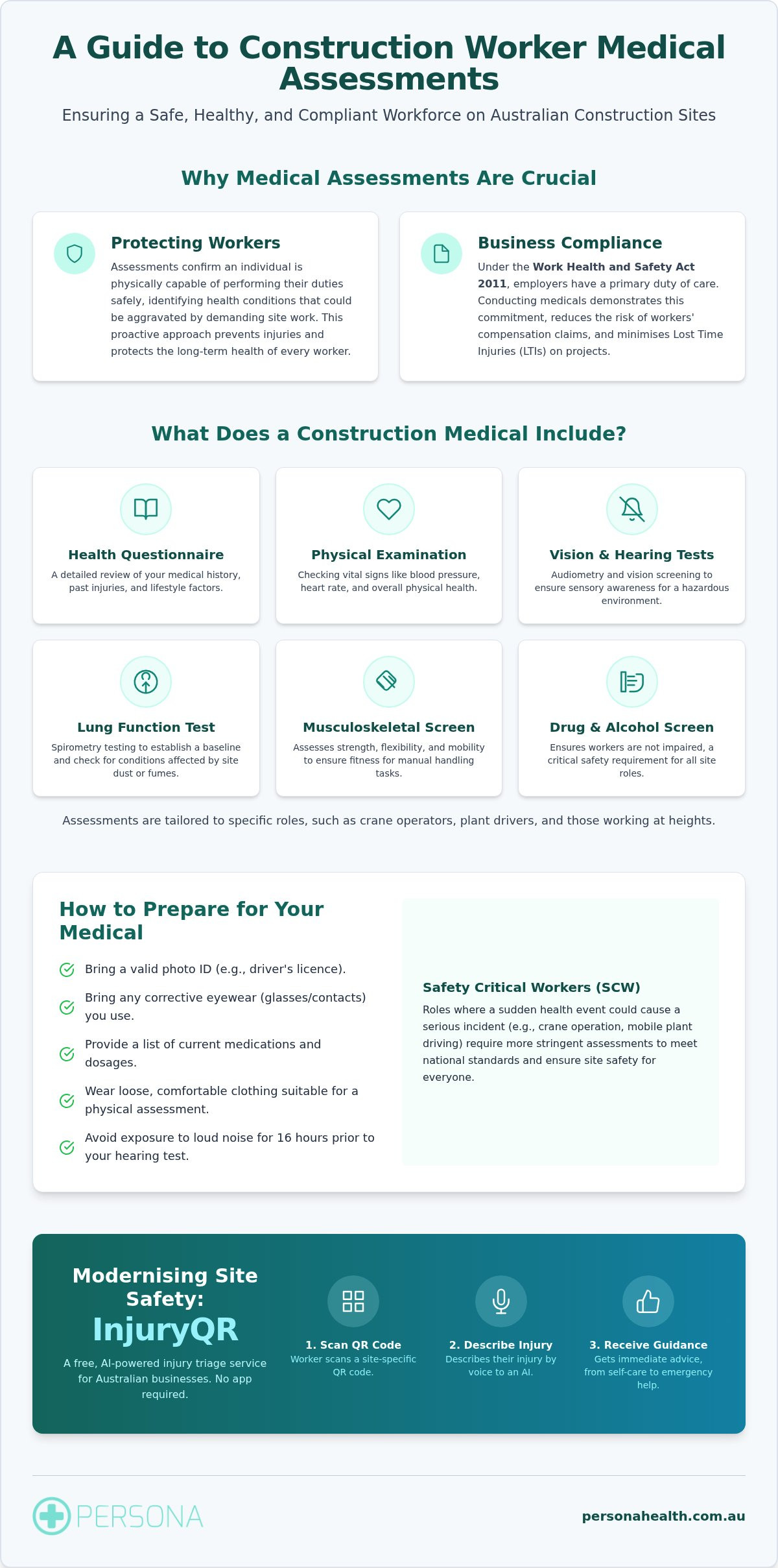
A construction worker medical assessment is a specialised health check used to confirm an individual is physically capable of performing site-based tasks safely. It identifies pre-existing conditions, such as chronic musculoskeletal issues or cardiovascular concerns, that could be aggravated by the physical demands of building and civil works. By ensuring that a worker’s health profile matches the requirements of their role, we protect both the individual and their colleagues from avoidable incidents. Ultimately, the assessment is a proactive risk management tool that aligns worker capacity with specific site demands.
Under the Work Health and Safety Act 2011, employers have a primary duty of care to ensure the health and safety of their workforce. These Occupational safety and health principles are the cornerstone of a safe workplace, ensuring that every person returns home in the same condition they arrived. Implementing a thorough construction worker medical assessment process demonstrates a commitment to these legal and ethical obligations.
To better understand the practical requirements for site clearance, watch this helpful video:
Legislative Framework and Duty of Care
SafeWork Australia provides the national framework for managing risks in high-risk industries like construction. State regulators, such as SafeWork NSW and WorkSafe Victoria, enforce these standards through regular site audits and inspections. As of 1 July 2026, approved Codes of Practice in NSW are mandatory; businesses must either follow these codes or prove they are managing hazards to an equal or higher standard. This shift places greater emphasis on verified competency and health monitoring. Furthermore, in South Australia, the working at height threshold for high-risk work was reduced to two metres on 1 July 2026, requiring updated medical considerations for those operating on ladders or scaffolding. Compliance with these evolving standards reduces the likelihood of workplace injuries and helps mitigate the financial impact of workers compensation claims.
Protecting the Workforce and the Business
Conducting pre-employment medicals provides a baseline health record that protects both the employee and the employer from future disputes regarding work-related injuries. Early detection of issues like hearing loss or respiratory decline allows for better workplace adjustments, which is particularly vital as Australia replaces Workplace Exposure Standards with more stringent Workplace Exposure Limits (WEL) from 1 December 2026. A healthy workforce is a more productive workforce, leading to fewer lost time injuries (LTIs) on major infrastructure projects. To support this, the Work Health and Safety Amendment (Digital Work Systems) Act 2026 now makes the use of digital safety systems an explicit duty. InjuryQR assists businesses in meeting this duty by providing a free, AI-powered triage service; workers scan a QR code to describe an injury by voice, receiving immediate guidance that ranges from self-care to emergency intervention.
What is Included in a Construction Medical Assessment?
A construction worker medical assessment isn’t a one-size-fits-all process. Instead, it’s carefully tailored to the specific role you’ll be performing on site. Whether your daily tasks involve heavy lifting, operating complex machinery, or working at heights, the assessment ensures your physical health aligns with those unique demands. This alignment is consistent with Master Builders Australia safety policies, which emphasise the importance of maintaining high safety standards across the building industry.
The process usually begins with a comprehensive health questionnaire. This covers your medical history, previous injuries, chronic conditions, and any current medications. Following this, a clinical examination focuses on your cardiovascular health, blood pressure, and basic musculoskeletal function to establish a clear picture of your overall well-being. The physical abilities test (PAT) is the most critical component for assessing a worker’s capacity for manual handling.
Physical Capacity and Musculoskeletal Testing
Testing goes beyond a simple check-up to include specific measurements of range of motion, grip strength, and the ability to lift weights safely. Functional assessments often simulate real-world site conditions by requiring you to squat, kneel, or climb. These tests are designed to ensure you won’t suffer a preventable injury when performing your daily duties. If you’re unsure about what your specific role requires, you can learn more about what happens in a pre-employment medical to help you prepare for your appointment.
Audiometry and Spirometry: Protecting Senses and Lungs
Protecting your long-term health means looking at more than just physical strength. Audiometric testing monitors for noise-induced hearing loss, a common issue on noisy Australian construction sites. Similarly, spirometry (lung function testing) is essential for anyone exposed to dust. This is particularly vital for those working around hazardous substances, and you can find detailed information on our crystalline silica medicals page. These tests help identify early signs of respiratory decline before they become permanent problems.
Drug and Alcohol Screening
Construction sites are safety-critical environments where impairment can lead to catastrophic accidents. To maintain a safe site for everyone, screening is usually conducted via urine or saliva samples in accordance with Australian Standards. This process ensures that every worker on site is fit for duty and capable of making sound decisions under pressure. For a deeper look at these requirements and how they are managed, refer to our Workplace Drug and Alcohol Testing guide.
Safety Critical Workers (SCW) and High-Risk Roles
In the context of a construction worker medical assessment, the term “Safety Critical Role” refers to any task where a sudden health event or incapacity could lead to significant harm to the worker, their colleagues, or the public. These roles carry a higher level of responsibility and, consequently, require more rigorous health monitoring. Common examples include crane operators, riggers, dogmen, and those operating heavy earthmoving plant. Unlike general labouring, these positions demand a high degree of cognitive alertness and physical stability at all times.
The primary goal for these assessments is to identify underlying conditions that might cause sudden impairment. For instance, uncontrolled diabetes or epilepsy could lead to a loss of consciousness while operating a multi-tonne crane in a busy CBD area like Parramatta. Persona Health clinicians are experts in determining fitness for duty for these high-risk positions, ensuring that every worker on your site meets the necessary health benchmarks to perform their job safely. We focus on clinical precision to ensure that “fit for work” actually means safe for the entire site.
Rail and Infrastructure Specific Requirements
Infrastructure projects across Australia often intersect with rail corridors, which brings a unique set of safety challenges. When this occurs, a standard medical is rarely sufficient. Most workers will require a Category 3 Rail Medical, which adheres strictly to the National Standard for Health Assessment of Rail Safety Workers. These specialised assessments place a heavy emphasis on sensory capabilities. We specifically test vision and hearing to ensure that a worker can reliably detect safety warnings and approaching trains even in high-noise environments. Our clinics in Rosebery and Cairnlea are fully equipped to handle these specific requirements with fast turnaround times for employer reports.
Fitness for Duty and Return to Work
Safety management doesn’t end once a worker is hired. If an individual sustains an injury, whether on site or elsewhere, a Fitness for Duty (FFD) medical is essential before they return to the site. This process confirms the injury has healed sufficiently and that the worker can resume their specific duties without risking a relapse or a secondary incident. It’s about more than just a “clearance” letter; it’s a detailed evaluation of functional capacity. Persona Health provides clear, actionable reports to site managers, outlining any necessary work restrictions or gradual return-to-work plans. For businesses looking for immediate support when an injury first occurs, InjuryQR offers a free, AI-powered triage service. By scanning a QR code and describing the incident by voice, workers receive instant guidance, which can significantly reduce Lost Time Injuries (LTIs) and streamline the subsequent construction worker medical assessment for returning to duty.
How to Prepare for Your Construction Medical: A Checklist
Proper preparation ensures that the medical results are accurate and the process is completed quickly. When you attend a construction worker medical assessment, seemingly small factors can significantly influence your clinical readings. We want you to feel supported and ready, so arriving well-hydrated and dressed in comfortable clothing suitable for physical activity is essential. You’ll likely be asked to perform functional movements, so gear that allows for a full range of motion is best. For employers, fast turnaround times for medical reports are essential for meeting project commencement dates and keeping major infrastructure works on schedule.
To ensure your team is ready for site, you can book a comprehensive assessment at any of our clinics in Parramatta, Rosebery, or Craigieburn.
Tips for a Successful Assessment
Understanding the “why” behind preparation steps can help reduce any pre-appointment nerves. Following these simple guidelines ensures your body is in its natural state during testing:
- Avoid loud noise: Stay away from heavy machinery or loud music for at least 16 hours before your hearing test. This prevents a temporary threshold shift, where your ears are still recovering from noise exposure, which could lead to an inaccurate audiometry result.
- Monitor stimulants: Limit caffeine and nicotine intake for 2 hours prior to the exam. These substances can artificially elevate your heart rate and blood pressure; staying away from them ensures your readings are stable and representative of your true health.
- Bring your aids: Always bring any prescription glasses, contact lenses, or hearing aids you use daily. If you have a complex medical history, bringing recent reports from your treating GP can help our clinicians make a faster, more informed decision regarding your fitness for duty.
Information for Site Managers and HR
Clear communication is the most effective way to reduce candidate anxiety and ensure a smooth process. Before the appointment, ensure the clinic has a detailed list of the physical demands of the specific job role. This allows our clinicians to tailor the functional testing to the actual tasks the worker will perform, whether that is heavy lifting in Gregory Hills or plant operation in Cairnlea. If you are looking for broader recruitment guidance, our Pre-Employment Medicals pillar provides extensive insights into building a compliant and healthy team.
Providing all necessary paperwork and job descriptions to the clinic in advance prevents delays. This proactive approach, combined with modern tools like InjuryQR for managing on-site incidents, creates a robust safety culture that protects both your workers and your business reputation. Our goal is to provide you with the clarity needed to get your workforce on site without unnecessary hurdles.
Persona Health: Expert Occupational Care for the Building Sector
Persona Health offers a streamlined approach to construction medicals across Sydney, Melbourne, and regional Australia. Our clinics in Parramatta, Rosebery, and Cairnlea are strategically located near major infrastructure hubs to ensure your team has easy access to expert care. We understand that in the building industry, time is money. That’s why we pride ourselves on fast turnaround times and an employer-focused approach to health and compliance. Whether you are managing a local residential build or a multi-billion dollar civil project, our network of over 100 affiliate clinics ensures we can support your project wherever it is located in Australia.
Our clinics in Gregory Hills, Dee Why, and Craigieburn further extend our reach, providing consistent, high-quality assessments that meet the rigorous demands of modern site requirements. We don’t just provide a service; we act as a modern professional partner, guiding you through the complexities of workforce health with clinical authority and deep empathy for the individual worker’s experience.
Innovative Triage with InjuryQR
Post-hire safety is just as important as the initial construction worker medical assessment, which is why we recommend InjuryQR. This free, AI-powered triage service requires no app installation, making it incredibly accessible for workers on-site. When an incident occurs, workers simply scan a QR code and describe their injury by voice. The AI then asks follow-up questions to determine the best course of action, ranging from self-care and telehealth to emergency intervention. This tool is a game-changer for reducing Lost Time Injuries (LTIs) and ensuring immediate Certificates of Capacity are issued when needed, keeping your project compliant with the latest WHS standards and the Work Health and Safety Amendment (Digital Work Systems) Act 2026.
Comprehensive Injury Management and Surveillance
Beyond initial medicals, we provide best practice injury management to get workers back to site safely and efficiently. Our team doesn’t just tick boxes; we focus on the individual’s recovery and functional capacity. Additionally, our on-site health surveillance services help monitor long-term exposure to hazards like noise and dust. This proactive monitoring is essential for meeting your obligations under the Privacy Act 1988 and relevant state legislation. Contact our team today to discuss a tailored health programme for your construction workforce and experience a partnership that prioritises both safety and productivity.
Securing Your Site and Protecting Your Workforce
Navigating the requirements for a construction worker medical assessment doesn’t have to be a source of stress for workers or site managers. By understanding the current legislative framework and preparing your team effectively, you ensure that safety remains a practical reality rather than just a compliance hurdle. We’ve explored how role-specific testing and modern triage tools like InjuryQR create a robust safety net that protects both individual health and project timelines.
Persona Health is here to support your next project with specialists in Safety Critical Worker assessments and convenient clinics across Sydney and Melbourne. We understand the fast-paced nature of the building industry, which is why we prioritise fast turnaround times for all medical reports to keep your workforce moving. Whether you’re operating in Parramatta or Craigieburn, our team is ready to help you meet your WHS obligations with clinical precision and genuine care.
Contact Persona Health to book your construction medical today and take the next step toward a safer, more productive workplace. We look forward to partnering with you to ensure your team remains fit, healthy, and ready for the challenges of the modern construction site.
Frequently Asked Questions
What is a construction worker medical assessment and who needs one?
A construction worker medical assessment is a specialised health evaluation designed to verify that an individual can safely perform the physical tasks required on a building site. It’s typically required for new employees, contractors, and anyone moving into a safety-critical role. The assessment ensures you meet the health standards set by SafeWork Australia and specific site requirements. Whether you’re a labourer or a crane operator, this process protects your long-term wellbeing and site safety.
How long does a construction medical take to complete?
Most assessments are completed within 45 to 90 minutes, though this varies based on the specific tests required for your role. A standard check includes a questionnaire and physical exam; however, roles requiring audiometry, spirometry, or drug screening will take longer. At our clinics in Parramatta and Cairnlea, we focus on efficient workflows to ensure you aren’t away from the site for longer than necessary while maintaining clinical thoroughness and accuracy.
What happens if I fail my construction worker medical?
Failing an assessment doesn’t always mean you can’t work; it often results in a “Fit with Restrictions” classification. Our clinicians work with you and your employer to identify workplace adjustments or medical treatments that can help you meet the required standards. If a significant health issue is found, we provide empathetic guidance on the next steps for your recovery. The goal is always to find a safe way for you to continue your career.
How often do construction workers need to have a medical?
The frequency of a construction worker medical assessment depends on your specific role and industry regulations. Generally, a full assessment is recommended every two years to monitor long-term health trends. However, safety-critical workers or those in rail corridors may require annual checks. Regular monitoring is vital for detecting early signs of conditions like noise-induced hearing loss or respiratory issues, ensuring you remain healthy throughout your working life and stay compliant with WHS laws.
What should I bring to my construction medical appointment?
You should bring a form of photo identification, such as a driver’s licence, and any prescription glasses or hearing aids you use. It’s also helpful to bring a list of current medications and relevant medical reports from your GP if you have a pre-existing condition. We recommend wearing comfortable, loose-fitting clothing and closed-toe shoes, as you’ll likely be asked to perform functional movements like squatting, lifting, or reaching during the physical capacity test.
Does a construction medical include a drug and alcohol test?
Yes, most construction medicals include a drug and alcohol screen to comply with site safety policies and Australian Standards. These tests are usually conducted via a urine or saliva sample to ensure all workers are fit for duty and not impaired by substances. Maintaining a drug-free environment is a critical part of managing psychosocial risks and physical hazards on high-risk sites, protecting everyone from the potential for catastrophic workplace accidents.
Are construction medicals private and who sees the results?
Your medical information is strictly protected under the Privacy Act 1988 and Australian health privacy principles. Your employer doesn’t receive your full clinical record; instead, they’re provided with a “Fitness for Duty” report. This report only details whether you’re fit for the role and any specific work restrictions required for your safety. Our clinics in Rosebery and Craigieburn maintain the highest standards of data security to ensure your personal health journey remains confidential.
Can I use a medical from a previous employer for a new job?
Generally, a new employer will require a fresh assessment to ensure your health profile matches their specific site risks and job descriptions. While some industry-wide certifications like Category 3 Rail Medicals may be transferable if they’re still current, most companies prefer their own baseline health record. This ensures that the construction worker medical assessment is tailored exactly to the tasks you’ll perform under their specific safety management system and duty of care.

Article by
Ian Nicholson
Ian is the Business Support Manager at Persona Health, where he plays a key role across IT, sales, marketing and business operations. With a broad skill set and a practical, solutions-focused approach, Ian helps drive the systems, communication and commercial strategy that support Persona Health’s continued growth across Australia.