

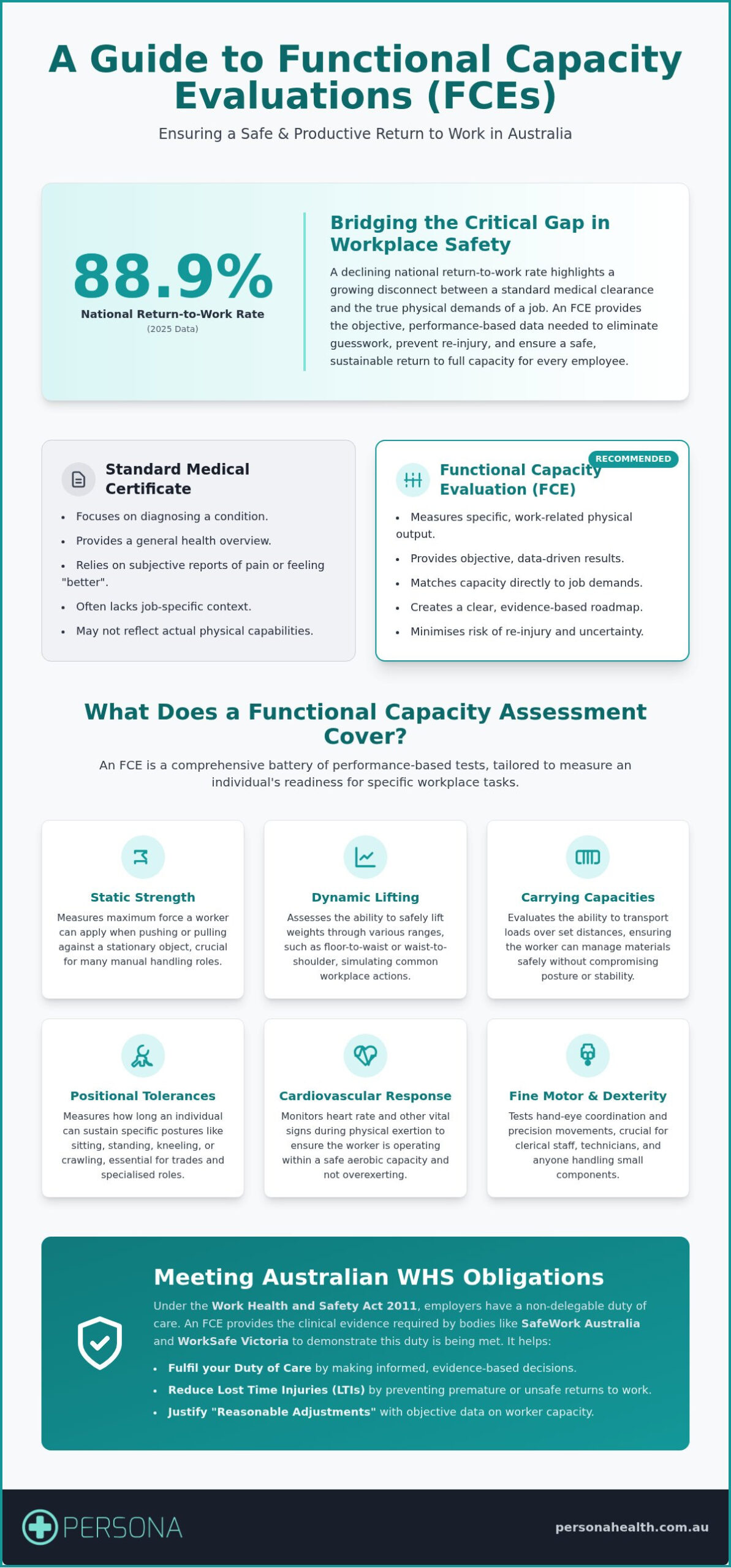
Did you know the national return-to-work rate in Australia dipped to 88.9% in 2025? This downward trend highlights a growing gap between standard medical clearance and the actual physical demands of the modern workplace, making a precise return to work assessment more critical than ever. It’s incredibly stressful for both employers and staff when a general practitioner’s report doesn’t quite capture the heavy lifting or high-pressure requirements of a specific role. You want your team back, but the fear of re-injury often creates a lingering sense of uncertainty for everyone involved.
This guide explains how a Functional Capacity Evaluation (FCE) provides the objective data needed to eliminate guesswork and ensure every step forward is a safe one. At Persona Health, we focus on bridging the gap between clinical recovery and sustainable productivity through detailed, performance-based testing. We will explore how these clinical assessments protect your business from risk, satisfy Australian WHS legislation, and provide a clear, evidence-based roadmap for returning your people to full capacity. From understanding physical limits to implementing a structured reintegration plan, you’ll discover how to manage workplace health and compliance with confidence.
Key Takeaways
- Understand how objective performance testing provides a more accurate picture of job readiness than a standard medical certificate.
- Learn how a return to work assessment resolves conflicting medical reports and provides a clear, evidence-based path for safe reintegration.
- Discover the specific physical metrics measured, such as lifting capacity and positional tolerances, to minimise the risk of workplace re-injury.
- Identify the key triggers for an FCE, particularly when there is a discrepancy between a worker’s reported symptoms and clinical findings.
- Get practical guidance on preparing for an assessment to ensure consistent effort and highly reliable reporting for your business.
Understanding Functional Capacity Evaluation (FCE) in the Australian Workplace
A Functional Capacity Evaluation (FCE) is a clinical, performance-based assessment designed to determine an individual’s physical ability to perform work-related tasks safely. Unlike a standard medical check, which focuses on diagnosing a condition or checking general health markers, an FCE measures specific physical output. It provides a data-driven foundation for a return to work assessment, ensuring that an employee isn’t just “feeling better” but is actually capable of meeting the physical demands of their role.
This process involves several key stakeholders. The employer needs to ensure they aren’t placing a worker at risk; the insurer requires objective data to manage claims efficiently. Simultaneously, the treating doctor uses the results to refine medical certificates, and the worker gains confidence knowing their limits are understood. Under Australian WHS legislation, employers have a non-delegable duty of care to provide a safe workplace. Using an FCE helps fulfil this duty by replacing subjective guesswork with clinical evidence.
The Core Purpose of a Functional Assessment
The primary goal is to quantify physical capabilities like static strength, dynamic lifting, and postural tolerances. It’s about matching the individual’s current capacity to the inherent requirements of their job. For example, if a role requires frequent overhead reaching or repetitive lifting of 15kg, the FCE tests those exact movements. This creates a baseline for injury management and helps determine if vocational retraining is necessary. By focusing on function rather than just pain levels, we can identify exactly what a worker can do safely today.
Australian Legislative Context: SafeWork and WorkSafe
In Australia, FCEs support compliance with the Work Health and Safety Act 2011. Whether you are operating under the NSW SIRA roadmap or the WorkSafe Victoria framework, having objective data is vital. These regulators prioritise person-centred early intervention to improve return-to-work rates. By using a fitness for duty assessment, businesses can make “reasonable adjustments” that are actually practical. This reduces the risk of re-injury and helps lower Lost Time Injuries (LTIs) across the organisation, ensuring compliance while supporting the individual’s recovery journey.
What Does a Functional Capacity Assessment Actually Cover?
An FCE isn’t just a single test. It’s a battery of clinical observations tailored to the individual. It forms the core of a reliable return to work assessment by providing a clear, evidence-based picture of what a person can actually do. By shifting the focus from “what is the injury?” to “what is the capability?”, we can create a much safer path back to the workplace.
The evaluation typically examines several key physical domains:
- Static strength: Measuring the maximum force a worker can apply while pushing or pulling against a stationary object.
- Dynamic lifting: Assessing the ability to lift weights from floor to waist, or waist to shoulder, which is essential for warehouse and construction roles.
- Carrying capacities: Evaluating the worker’s ability to transport loads over specific distances without compromising their posture or safety.
Positional tolerances are equally vital. We measure how long a worker can maintain specific postures, such as sitting, standing, kneeling, or crawling. These metrics are critical for tradespeople or those in the rail industry, where sustained awkward postures are often a daily requirement.
During these tasks, clinicians monitor cardiovascular response. Tracking heart rate ensures the worker is operating within a safe aerobic zone and isn’t overexerting themselves. For clerical or technical staff, we also include fine motor and dexterity testing to assess typing speed or the ability to handle small components with precision. If you are managing a complex case, our clinicians can help you optimise your injury management strategy through these objective insights.
Physical and Biomechanical Testing
We use standardised tools like dynamometers to measure grip strength and upper limb function. Spinal flexibility and range of motion are also assessed to ensure manual handling tasks don’t place undue stress on the musculoskeletal system. Material handling in an FCE is defined as the manual act of lifting, lowering, carrying, pushing, or pulling loads within the specific weight limits required for a worker’s role.
Assessing Cognitive and Psychological Readiness
A successful return to work involves more than just physical healing. We look for “yellow flags,” which are psychosocial barriers like a fear of re-injury or low confidence. Assessors carefully observe consistency of effort to ensure the results are a true reflection of the worker’s current capacity. For businesses looking to streamline the early stages of recovery, InjuryQR provides a free, AI-powered triage service that helps managers decide if a full FCE or a telehealth consult is the best next step.
Indications for an FCE: When is it the Right Choice for Your Business?
Deciding when to request an FCE is a strategic choice for Australian businesses. While many injuries follow a predictable recovery path, others involve a mismatch between a worker’s reported pain levels and the clinical findings on a scan. In these instances, a return to work assessment powered by an FCE provides the objective clarity needed to move forward. It moves the conversation away from subjective feelings toward clinical data, showing exactly what a worker can safely perform. This is especially helpful when conflicting medical reports from general practitioners create uncertainty about a worker’s actual physical limits.
These evaluations are also indispensable for permanent impairment ratings and legal case settlements. By quantifying exactly how much function has been lost or retained, all parties can reach a fair and evidence-based conclusion. For long-term injured workers who have plateaued in their rehabilitation, an FCE helps determine if they have reached Maximum Medical Improvement (MMI). It provides the necessary documentation for insurers and employers to decide whether a worker can return to their original role or if a vocational change is required.
In safety-critical sectors like heavy infrastructure or rail, the stakes are significantly higher. An error in judgement regarding physical capacity can lead to catastrophic site incidents. Using standardised assessments ensures that every person on site is physically capable of meeting the inherent requirements of their role, regardless of their injury history. This proactive approach reduces workplace risk and protects the business from potential liability.
Managing Complex Return to Work (RTW) Cases
When recovery is non-linear, a one-size-fits-all approach often fails. FCE data allows us to design a graduated return to work programme that scales with the worker’s verified capacity. This precision reduces the likelihood of re-injury, which is a major driver of rising workers’ compensation premiums. For businesses dealing with tricky claims, integrating professional injury management services ensures that the transition back to the tools is supported by clinical experts who understand the nuances of Australian workplace law and the practicalities of the worksite.
FCEs in Pre-Employment and Fitness for Duty
Sometimes, a standard pre-employment medical simply isn’t enough for high-risk roles. If a candidate is entering a position with extreme physical demands, a deeper functional dive provides peace of mind. This is particularly relevant for Category 3 Rail Medicals, where track safety depends on physical agility and stamina. Establishing a baseline of physical health for new hires doesn’t just protect the worker; it protects the long-term health of your entire workforce by ensuring everyone is fit for the tasks at hand.
Preparing for Your Assessment: A Guide for Workers and Employers
Preparing for a return to work assessment doesn’t need to be a source of anxiety. For the worker, it’s an opportunity to demonstrate their progress in a safe, controlled environment. For the employer, it’s about getting the clarity needed to fulfil duty of care obligations. Most evaluations take between two and four hours, depending on the complexity of the job requirements. It’s a comprehensive session, so arriving prepared is the first step toward a successful outcome.
To ensure the most accurate results, workers should bring the following to their appointment:
- Comfortable, non-restrictive clothing such as gym gear or loose work clothes.
- Supportive, closed-toe footwear, ideally the boots or shoes worn during a typical shift.
- A current list of medications and any recent medical imaging or specialist reports.
The most important factor during testing is honesty and maximal consistent effort. This doesn’t mean pushing through sharp, limiting pain, but it does mean showing the clinician the full extent of current capabilities. The assessor isn’t just looking at the weight being moved; they are observing lifting techniques, monitoring heart rate, and watching for signs of physical fatigue to ensure every movement remains safe. If you need to organise a professional evaluation for your team, you can book a fitness for duty assessment at one of our clinics today.
The Assessment Day Process
The session begins with a clinical interview to discuss the injury history, current symptoms, and the specific demands of the role. We then move into physical testing, starting with simple range-of-motion checks before progressing to work-simulated tasks. The clinician will stop the assessment immediately if a worker reaches a safe physiological limit or demonstrates unsafe mechanics. This approach prevents re-injury while still capturing the objective data required for a robust report.
Understanding the FCE Report
Following the evaluation, the clinician translates the data into a detailed report that aligns with Australian standards, such as the SIRA Certificate of Capacity or WorkSafe Victoria frameworks. Employers will receive a clear outcome, such as “Fit with Restrictions” or “Unfit for Pre-Injury Duties.” This document provides actionable advice on how to modify workstations or tools. For immediate assistance with new incidents, many Australian businesses use InjuryQR to triage injuries via voice before they reach this stage, helping to manage the initial recovery process and reduce Lost Time Injuries (LTIs) from day one.
Professional Injury Management and FCE Services at Persona Health
Choosing the right partner for a return to work assessment is about more than just finding a clinic. It’s about finding a team that understands the delicate balance between clinical recovery and operational necessity. At Persona Health, our clinical expertise across Sydney and Melbourne is built on a foundation of professional authority and deep empathy. We know that every injured worker is an individual with specific needs, and our assessments are tailored to reflect that uniqueness. With our core clinics in Parramatta, Rosebery, and Craigieburn, we provide accessible, high-quality care that prioritises fast turnaround times for comprehensive functional reports, ensuring your business can make informed decisions without delay.
Innovative Triage with InjuryQR
We believe that the best way to manage a complex injury is to intervene as early as possible. This is why we provide InjuryQR, a free, AI-powered triage service designed specifically for Australian workplaces. This tool requires no app installation. Workers simply scan a QR code and describe their injury using their voice. The AI then guides them through a series of follow-up questions to determine the best course of action, whether it’s self-care, a telehealth consult, or an immediate clinic visit. By capturing data at the point of injury, businesses can often secure an immediate Certificate of Capacity and significantly reduce Lost Time Injuries (LTIs). This proactive approach often resolves minor issues before they escalate, potentially preventing the need for a more complex FCE later in the recovery journey.
Our National Clinic and Affiliate Network
While our flagship clinics in Sydney and Melbourne offer a clinical hub for excellence, our reach extends across the entire country. We utilise an extensive network of over 100 affiliate clinics and offer mobile on-site services to ensure your workforce is covered, no matter where they are located. A key advantage of the Persona Health approach is that our occupational physicians and senior clinicians oversee the assessment process, providing a level of clinical rigour that virtual-only providers cannot match. This hands-on, employer-focused approach ensures that every report we produce is legally robust, clinically accurate, and practically useful. If you are ready to streamline your workforce health and compliance, contact our team today to book a consultation or request a quote for our specialised services.
Securing a Safe and Sustainable Return to Work
A Functional Capacity Evaluation provides the objective bridge between clinical recovery and the practical demands of the Australian worksite. By replacing subjective guesswork with performance-based data, you can eliminate the uncertainty that often surrounds a return to work assessment. This evidence-based approach ensures that every worker returns to a role that matches their verified physical capacity, significantly reducing the risk of re-injury and helping to lower your organisation’s Lost Time Injuries.
At Persona Health, our expert team of Occupational Physicians and Allied Health professionals is here to guide you through every step of the process. With clinics located across Sydney and Melbourne and a reputation for fast turnaround times on all functional reports, we provide the clarity and speed required for modern injury management. We’re committed to the long-term health of your workforce and the compliance of your business.
Book a Functional Capacity Evaluation or Injury Management Consultation with Persona Health today to ensure your team is supported by clinical excellence. Investing in a precise assessment today builds a stronger, safer, and more resilient workplace for tomorrow.
Frequently Asked Questions
How long does a Functional Capacity Evaluation take to complete?
A Functional Capacity Evaluation typically takes between two and four hours to complete. The exact duration depends on the complexity of your job description and the nature of your injury. During this time, the clinician will conduct an initial interview before moving into physical testing. This ensures we capture a full range of data without rushing the process or compromising your safety during the evaluation.
Can I fail a Functional Capacity Evaluation?
You cannot technically fail a Functional Capacity Evaluation because it’s an objective measurement of your current abilities rather than a competitive test. The goal is to identify your safe physical limits to ensure a sustainable return to work assessment. The report simply outlines what you can safely do today. This protects you from re-injury by ensuring your duties don’t exceed your verified clinical capacity.
What should I wear to my FCE appointment?
You should wear comfortable, non-restrictive clothing and supportive, closed-toe footwear to your appointment. Many people choose gym gear or loose-fitting work clothes that allow for a full range of movement. If your job requires specific safety gear, such as steel-capped boots, it’s often helpful to bring those along. This helps the clinician observe your technique in the footwear you’ll actually use on the job.
Is an FCE mandatory for a workers compensation claim in Australia?
An FCE isn’t mandatory for every workers’ compensation claim, but it’s often requested when there’s uncertainty about a worker’s physical limits. Insurers and employers use these assessments to satisfy their duty of care under Australian WHS legislation. If your recovery has plateaued or there’s a discrepancy in medical reports, an FCE provides the objective evidence needed to move the claim forward and ensure your safety.
What is the difference between an FCE and a pre-employment medical?
The main difference is that an FCE is a performance-based assessment of specific tasks, while a pre-employment medical is a general health screening. While a medical check looks at your overall health markers, an FCE measures your actual strength and endurance for a specific role. It provides a more detailed return to work assessment by testing your ability to lift, carry, and maintain postures required for your job.
Who pays for the Functional Capacity Evaluation?
The cost of a Functional Capacity Evaluation is typically covered by the employer or the workers’ compensation insurer. In the Australian system, the party that requests the assessment is generally responsible for the professional fees. You won’t be expected to pay for the evaluation yourself. This ensures that objective clinical data is accessible to all stakeholders involved in your rehabilitation and workplace reintegration.
How long is an FCE report valid for?
An FCE report is generally considered valid for three to six months, though this depends on your clinical progress. If your physical condition improves significantly through rehabilitation, or if you experience a setback, the data may no longer be accurate. In these cases, a new assessment might be necessary to ensure your work duties still align with your current physical capabilities and safety requirements.
Can my own GP perform a Functional Capacity Evaluation?
Your own GP cannot perform a Functional Capacity Evaluation because it requires specialised equipment and a significant amount of time. While your GP provides essential medical care and diagnosis, an FCE is conducted by Allied Health professionals or Occupational Physicians. These specialists use standardised tools and work-simulation tasks that aren’t typically available in a general practice setting to measure your physical output accurately.

Article by
Ian Nicholson
Ian is the Business Support Manager at Persona Health, where he plays a key role across IT, sales, marketing and business operations. With a broad skill set and a practical, solutions-focused approach, Ian helps drive the systems, communication and commercial strategy that support Persona Health’s continued growth across Australia.