

An independent medical examiner is not there to challenge your injury, but to provide the clinical clarity needed to move your recovery forward. It’s natural to feel unease when asked to see a doctor you’ve never met, especially when your return to work or compensation claim feels like it’s hanging in the balance. You might wonder why your GP’s opinion isn’t enough or how this new assessment will impact your future. We understand that the workers’ compensation system often feels like a maze of complex legislation and clinical jargon that leaves you feeling more like a case number than an individual.
This 2026 guide replaces that uncertainty with confidence by explaining how an independent medical examiner operates within the Australian framework. You’ll learn about the vital differences between your treating doctor and an IME, the standards set by bodies like SafeWork Australia, and how evidence-based opinions lead to faster claim resolutions. We also explore how tools like InjuryQR are streamlining triage to ensure you receive the right support immediately. This guide provides a clear roadmap, helping you approach your appointment with a focus on your long-term health and recovery.
Key Takeaways
- Learn exactly how an independent medical examiner provides objective clinical clarity to resolve complex injury claims and support recovery.
- Identify the specific workplace scenarios that necessitate an IME, including when a worker’s recovery timeline exceeds standard clinical expectations.
- Master the preparation steps for both face-to-face and telehealth assessments to ensure the process remains fair, transparent, and stress-free.
- Discover how expert medical opinions and tools like InjuryQR work together to reduce lost time injuries and accelerate the return to work.
- Understand the 2026 legislative landscape and fee structures across Australian jurisdictions to maintain compliance with SafeWork Australia standards.
What is an Independent Medical Examiner (IME)?
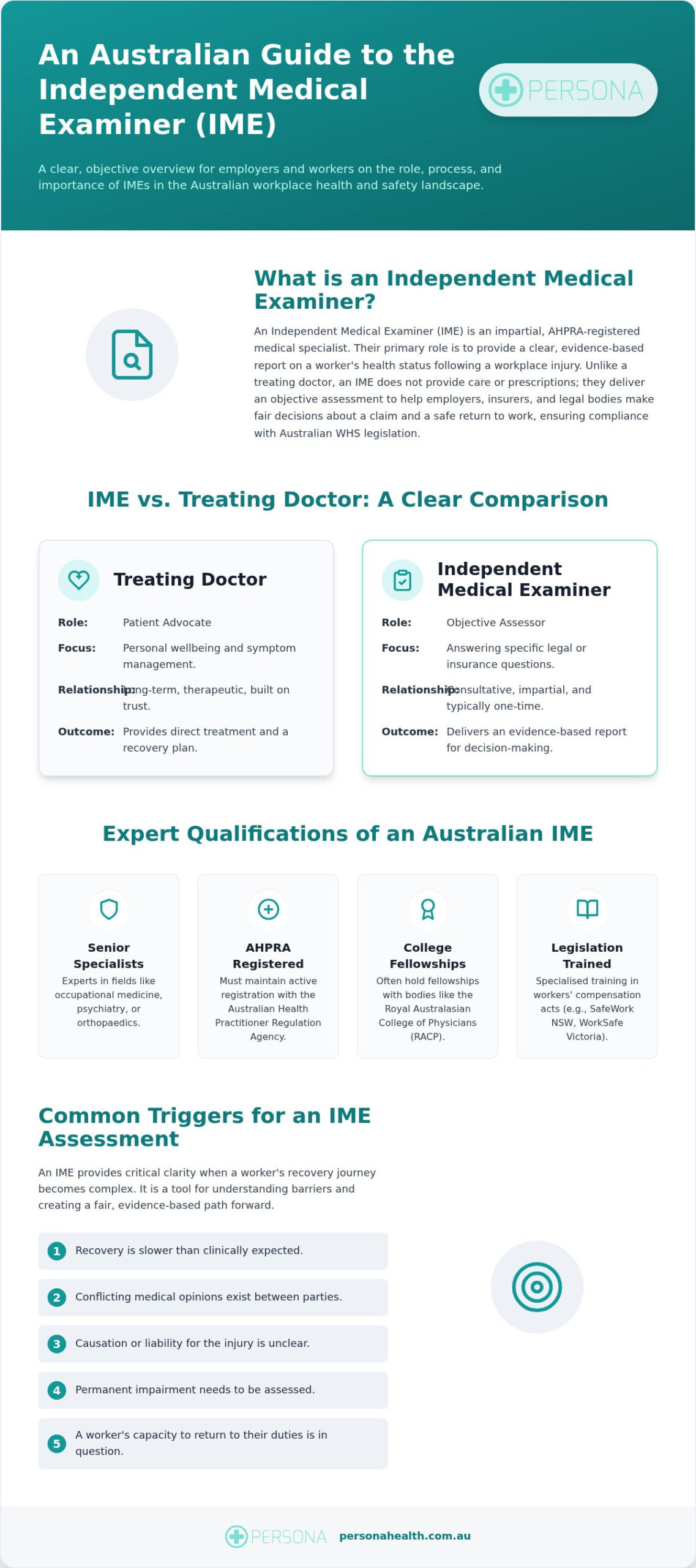
An independent medical examiner is an impartial medical specialist registered with the Australian Health Practitioner Regulation Agency (AHPRA) who assesses an individual’s health status and fitness for duty. Unlike a general practitioner who manages your daily health needs, an IME is engaged as a neutral third party to provide a clear perspective on a workplace injury or medical condition. Their primary goal is to deliver an evidence-based report that assists employers, insurers, and legal bodies in making informed decisions about a claim or a worker’s capacity to return to the workplace safely.
The examiner doesn’t provide ongoing care, prescriptions, or treatment plans for the individual they see. Instead, they conduct a thorough Independent Medical Examination (IME) to answer specific questions regarding diagnosis, injury causation, and future medical requirements. This clinical clarity helps ensure that the recovery process is based on objective data, providing a fair outcome for both the worker and the employer while ensuring compliance with local WHS legislation.
To better understand how these specialists operate in a clinical and legal context, watch this helpful video:
The Difference Between an IME and a Treating Doctor
The relationship you have with your treating GP is built on long-term advocacy and clinical recovery. Your doctor’s priority is your personal wellbeing and managing your symptoms through direct treatment. In contrast, an independent medical examiner focuses on objective assessment. They aren’t there to replace your doctor, but to provide a specialised snapshot of your condition at a specific point in time.
While your GP might focus on how you feel during a consultation, an IME looks at how your injury aligns with clinical benchmarks and workplace requirements. This relationship is strictly consultative. It doesn’t involve the traditional doctor-patient bond, which allows the examiner to remain completely unbiased when answering complex legal or insurance questions for Australian workplaces.
Qualifications and Expertise of Australian IMEs
Not every doctor can perform these specialised assessments. Examiners are typically senior specialists in fields such as occupational medicine, psychiatry, or orthopaedics. They must maintain active registration with AHPRA and often hold fellowships with prestigious bodies like the Royal Australasian College of Physicians (RACP). This high level of expertise ensures that every assessment is conducted with clinical precision and professional authority.
Many IMEs also undergo additional training in permanent impairment assessment and state-specific workers’ compensation legislation, such as the guidelines set by SafeWork NSW or WorkSafe Victoria. This ensures their reports meet the high evidentiary standards required by Australian courts and tribunals. By engaging a specialist with this level of expertise, businesses can trust that the medical opinions provided are robust, defensible, and focused on the individual’s unique path to regeneration and health.
When is an IME Assessment Necessary for Australian Workplaces?
Recovery from a workplace injury isn’t always a linear process. Sometimes, despite the best efforts of the treating doctor and the worker, progress stalls or becomes unexpectedly complex. In these moments, an independent medical examiner provides the necessary clinical insight to understand the underlying barriers to recovery. Persona Health uses these assessments to bridge the gap between medical theory and workplace reality, ensuring both the employer and employee have a fair, evidence-based path forward that focuses on the individual’s unique capacity for regeneration.
Common Triggers for an Independent Assessment
Several specific scenarios often lead to a formal referral. These are often triggered when a worker’s recovery is slower than clinically expected for their specific injury type, or if there is a disagreement between the treating doctor and the employer regarding the worker’s fitness for duty. Complex cases involving pre-existing conditions also necessitate a specialist opinion to determine work-relatedness. Primary triggers include:
- Assessing current and future capacity for work to ensure a safe return to the workplace.
- Reviewing the appropriateness of proposed treatment plans or major surgeries to ensure they align with Australian Standards.
- Determining the exact cause of a condition when multiple factors or previous injuries are at play.
These assessments are vital for maintaining compliance with SafeWork Australia standards and local WHS legislation. They provide a transparent framework for decision-making, helping to resolve uncertainty and anxiety for all parties involved in the claim process.
Early Triage: Using InjuryQR to Manage Risks
While formal assessments are essential for complex cases, many minor issues can be resolved through immediate intervention. We recommend Australian businesses utilise InjuryQR, a free, AI-powered triage service that requires no app installation. When an incident occurs, the worker simply scans a QR code and describes their injury by voice. The AI-driven system then asks follow-up questions to provide an immediate outcome, ranging from simple self-care to telehealth or emergency intervention.
This immediate response is a game-changer for modern injury management. It can provide instant Certificates of Capacity, which significantly reduces Lost Time Injuries (LTIs) and keeps the recovery process moving from day one. By managing risks early through digital triage, you can often provide the support a worker needs before a situation escalates to the point of requiring an independent medical examiner. If you are looking to improve your workplace safety outcomes, exploring an integrated injury management approach can provide the stability and clinical authority your team needs.
The IME Assessment Process: A Step-by-Step Breakdown
The process of seeing an independent medical examiner is a structured and transparent journey designed to replace clinical uncertainty with objective facts. It isn’t a standard medical consultation focused on treatment; rather, it’s a forensic review of an injury’s impact on a worker’s life and capacity. This methodical approach ensures that every medical opinion is evidence-based and consistent with the requirements of Australian compensation schemes and WHS legislation.
Step 1: The Referral and Document Review
Before the worker even walks through the clinic door, the process starts with a formal letter of instruction. This document, provided by the employer or insurer, outlines the specific clinical questions the specialist must answer. These questions often focus on the work-relatedness of the injury, the necessity of current treatments, or the worker’s readiness to return to modified duties.
Specialists spend significant time reviewing previous medical records, including GP notes, specialist reports, and hospital discharge summaries. This provides the necessary context to understand the history of the injury and any pre-existing conditions. Persona Health prioritises thorough document review for accuracy, ensuring the examiner has a complete picture before the clinical assessment begins.
Step 2: The Clinical Examination
The next stage involves a face-to-face or telehealth clinical examination with the specialist. This assessment is tailored specifically to the nature of the injury, whether it’s orthopaedic, neurological, or psychiatric. Unlike a treating doctor’s visit, the focus here is on functional capacity and objective clinical findings rather than ongoing symptom management.
Workers are encouraged to bring any recent X-rays, MRI results, or other imaging to the appointment to assist the examiner. The examination is conducted with the utmost professionalism and respect, ensuring the individual feels heard while the specialist gathers the data needed for a fair assessment. This step is crucial for determining how the injury affects daily activities and workplace performance.
Step 3: The IME Report and Recommendations
Once the examination is complete, the specialist synthesises all the information into a comprehensive independent medical examiner report. This document provides clear, definitive answers to the questions raised in the initial referral. It often includes specific recommendations for return-to-work plans, identifying exactly which duties are safe for the worker to perform.
Persona Health understands that delays in reporting can stall the entire injury management process. We ensure industry-leading turnaround times, delivering reports promptly to the requesting party so that decisions regarding claims and rehabilitation can be made without unnecessary wait times. This efficiency helps reduce anxiety for the worker and provides the employer with a clear path forward.
How to Prepare for an Independent Medical Examination
Preparation is the foundation of a smooth and stress-free assessment. While the thought of seeing an independent medical examiner can sometimes cause a degree of anxiety, understanding the process helps replace uncertainty with confidence. These appointments are a standard, objective part of the Australian workers’ compensation landscape. They are designed to provide a fair, evidence-based snapshot of your health and capacity. Persona Health clinics across Sydney and Melbourne, including our professional centres in Parramatta, Rosebery, Gregory Hills, and Dee Why, as well as Cairnlea and Craigieburn, are designed to be welcoming environments where your individual needs are prioritised.
Practical Tips for Workers
To ensure the specialist has everything they need to provide an accurate opinion, being organised is essential. The examiner will need to understand the full context of your recovery and how your injury impacts your life. We recommend following these practical steps:
- Bring a comprehensive list of all current medications and dosages, along with any recent medical reports or specialist letters.
- Arrive at least 15 minutes early to the clinic to complete any necessary paperwork in a calm, relaxed manner.
- Wear comfortable, loose-fitting clothing that allows for a physical assessment if your injury is musculoskeletal or requires a range-of-motion check.
- Be honest and detailed when describing your symptoms. Explain clearly how the injury affects your daily household tasks, hobbies, and specific work duties.
There is no need to downplay or exaggerate your condition. The examiner is looking for a truthful clinical picture to assist in your regeneration and long-term health goals. A transparent conversation ensures the final report is a fair reflection of your current status.
The Role of the Employer in the Process
Employers play a vital role in ensuring the IME journey is viewed as a supportive step toward recovery rather than a hurdle. Clear communication is the best way to reduce worker anxiety. Explain that the assessment is an objective tool used to ensure they are receiving the right support and that any return-to-work plan is safe and sustainable. This transparency builds trust and helps maintain a positive workplace culture during a difficult time.
It’s also important for employers to provide the examiner with an accurate, up-to-date job description. This allows the specialist to make a precise fitness for duty assessment based on the actual physical or psychological demands of the role. For broader advice on maintaining a safe and compliant workplace, you can explore our resources on Injury Management. If you need to book an assessment or require expert guidance on your occupational health requirements, contact the Persona Health team today to ensure your workforce remains healthy, safe, and productive.
Persona Health: Professional IME Services in Sydney and Melbourne
Persona Health stands as a trusted partner in the Australian occupational health landscape, delivering high-quality Independent Medical Examinations that balance clinical precision with a deeply empathetic approach. Our experienced Occupational Physicians understand that behind every claim is an individual looking for a path to recovery. We provide evidence-based reports that serve as a definitive guide for injury management, ensuring that every medical opinion is robust, transparent, and focused on the person’s unique capacity for regeneration. By choosing an independent medical examiner from our team, you gain access to industry-leading turnaround times that keep the recovery process moving without unnecessary delays.
Our Clinic Network and Mobile Services
We provide accessible care through our strategically located clinics in Sydney and Melbourne. You can find our professional teams in Parramatta, Rosebery, Gregory Hills, and Dee Why in Sydney, as well as Cairnlea and Craigieburn in Melbourne. For larger organisations with a national footprint, our extensive network of over 100 affiliate clinics ensures consistent, high-quality assessments across every state and territory. We also offer Australia-wide mobile services and on-site health surveillance for businesses that require a more proactive, preventative approach to workforce wellbeing. This comprehensive reach allows us to support your team wherever they are located, providing the stability and reliability you expect from a modern health partner.
Why Choose Persona Health for Your Assessments?
Our approach is fundamentally employer-focused, meaning we understand the practical business needs of reducing workplace risk while maintaining a commitment to workforce health and compliance. We don’t just provide a report; we provide a clear, actionable roadmap for a safe and sustainable return to work. Every assessment is conducted in full compliance with relevant Australian legislation, including SafeWork NSW, WorkSafe Victoria, and Comcare guidelines. We ensure that our findings are communicated in plain English, making it easier for you to implement recommendations and support your employees effectively. Our goal is to deactivate uncertainty and activate the internal resources needed for a successful recovery.
Whether you are managing a complex injury management case or need a definitive opinion on fitness for duty, our team is here to lead the way. We combine modern tools like InjuryQR with traditional clinical expertise to deliver outcomes that benefit both the business and the individual. Contact the Persona Health team today to discuss your specific requirements and learn how our tailored assessments can strengthen your workplace safety strategy and support your team’s long-term health goals.
Moving Forward with Clinical Clarity and Confidence
Understanding the role of an independent medical examiner is the first step toward navigating the workers’ compensation system with confidence. These assessments are not hurdles, but essential tools for clinical clarity that ensure every recovery journey is based on objective evidence. By combining thorough preparation with modern triage solutions like InjuryQR, businesses can significantly reduce lost time and support their workers’ return to health more effectively. This evidence-based approach removes the guesswork from injury management, providing a stable foundation for decision-making and professional regeneration.
Persona Health is committed to this process, offering a network of clinics across Sydney and Melbourne and a team of experienced Occupational Physicians dedicated to workforce wellbeing. We prioritise fast report turnaround times to ensure that your injury management strategy remains proactive and compliant with all Australian WHS standards. Whether you’re an employer seeking a definitive fitness for duty assessment or a worker preparing for an appointment, expert guidance is always within reach.
Contact Persona Health for expert Independent Medical Examinations today and let our team help you build a safer, more resilient workplace. Your path to a healthier workforce starts with the right medical partnership.
URL Slug: independent-medical-examiner-australia-2026-guide

Article by
Ian Nicholson
Ian is the Business Support Manager at Persona Health, where he plays a key role across IT, sales, marketing and business operations. With a broad skill set and a practical, solutions-focused approach, Ian helps drive the systems, communication and commercial strategy that support Persona Health’s continued growth across Australia.