

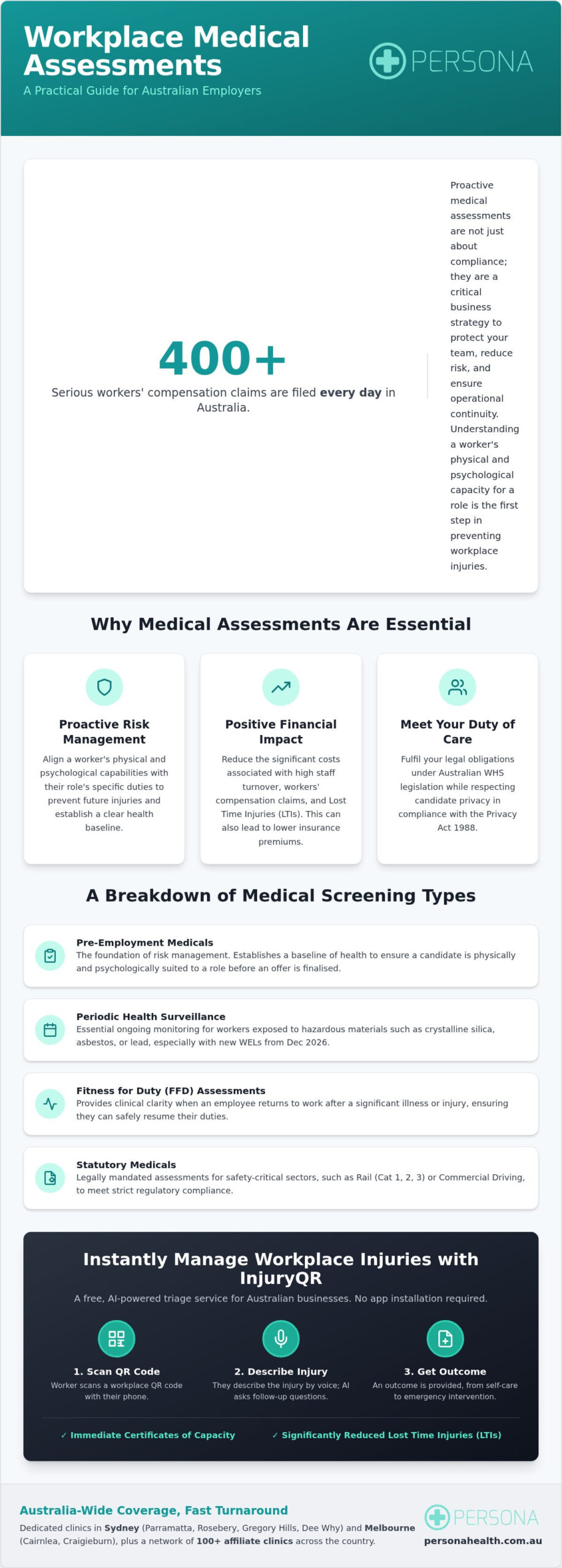
With more than 400 serious workers’ compensation claims filed every single day across Australia, the margin for error in workforce safety has never been smaller. It’s understandable if you feel overwhelmed by the shifting landscape of SafeWork regulations or the transition to new Workplace Exposure Limits (WELs) arriving in December 2026. You want to protect your team and your business, but the administrative weight of coordinating every workplace medical assessment often feels like a constant hurdle to recruitment and operational flow.
We recognise that your priority is a healthy, productive workforce, not a mountain of paperwork. This guide will help you master these complexities, ensuring your screenings are a strategic asset rather than just a compliance checkbox. You’ll gain a clear understanding of mandatory assessment types for high-risk industries, learn how to streamline your reporting for faster turnaround times, and discover how modern triage tools like InjuryQR can reduce lost time injuries. By the end of this guide, you’ll have the practical knowledge to reduce workplace risk and manage your legislative duties with absolute confidence.
Key Takeaways
- Understand how a workplace medical assessment ensures a worker’s physical and psychological capabilities align with their specific role duties to prevent future injuries.
- Learn the differences between baseline pre-employment checks and mandatory periodic health surveillance for high-risk materials like crystalline silica and asbestos.
- Discover what to expect during the clinical assessment process and how to manage sensitive health data in compliance with the Privacy Act 1988.
- Find out how specialised clinics in Sydney and Melbourne, combined with a 100-clinic affiliate network, can reduce recruitment delays and improve reporting turnaround times.
- Explore how integrating AI-powered triage tools like InjuryQR can help your business manage workplace injuries instantly and reduce Lost Time Injuries.
Why Workplace Medical Assessments are Essential for Risk Management
A workplace medical assessment serves as a vital safeguard, ensuring that a candidate’s physical and psychological capabilities align perfectly with the demands of their specific role. It isn’t merely a box-ticking exercise; it’s a clinical evaluation designed to identify whether an individual can safely perform their duties without risking their own wellbeing or that of their colleagues. By understanding what is a physical examination? in a vocational context, employers can better appreciate how these screenings detect pre-existing conditions that might otherwise be aggravated by specific work tasks.
Identifying these vulnerabilities early is an effective way to prevent workplace injuries before they occur. When a worker is placed in a role that exceeds their physical capacity, the risk of a serious workers’ compensation claim increases significantly. In the 2023-24 period, Australia saw 146,700 serious claims, with body stressing and falls being the leading causes. A proactive workplace medical assessment directly addresses these risks, establishing a clear health baseline for employees entering hazardous or high-stress environments.
The Financial Impact of Proactive Screening
Investing in early screening reduces the substantial costs associated with failed probations and high staff turnover. When you ensure a candidate is physically capable of meeting the job’s demands, you protect your recruitment budget from the drain of repeated hiring cycles. Insurers often view a robust medical screening program as a sign of sophisticated risk management, which can lead to lower premiums over time. For high-risk Australian industries, the ROI of medical assessments is measured by the significant reduction in Lost Time Injuries (LTIs) and the preservation of long-term operational continuity.
Duty of Care and the Australian Employer
Under Australian Work Health and Safety (WHS) legislation, every Person Conducting a Business or Undertaking (PCBU) has a primary duty of care to ensure the health and safety of their workers. Assessments help you meet this legal obligation by providing objective data on a worker’s fitness for duty. However, this must be balanced with the candidate’s right to privacy under the Privacy Act 1988. An expert occupational physician plays a crucial role here, providing a balanced opinion that informs the employer of the candidate’s functional capacity without disclosing unnecessary personal medical details. This professional distance builds trust and ensures that your hiring decisions are both compliant and compassionate.
A Comprehensive Breakdown of Medical Screening Types
Every role carries a unique risk profile, which is why a workplace medical assessment isn’t a one-size-fits-all solution. Depending on the industry, an assessment might be a baseline check for a new hire or a legally mandated periodic review for those exposed to hazardous substances. These screenings ensure that the person and the position are a safe match, protecting both the individual and the business.
- Pre-employment medicals: These act as the foundation of your risk management strategy, occurring before a formal offer is made to establish a baseline of health.
- Periodic health surveillance: Essential for workers exposed to lead, asbestos, or crystalline silica. This monitoring is particularly critical as Australia transitions to new Workplace Exposure Limits (WELs) on 1 December 2026.
- Fitness for duty (FFD) assessments: These provide clinical clarity and peace of mind when an employee returns from a significant period of illness or injury.
- Statutory medicals: Legally mandated checks for specific sectors, such as rail or commercial driving, where public safety and regulatory compliance are paramount.
Pre-Employment and Functional Assessments
Standard clinical tests typically include cardiovascular health, vision, and musculoskeletal integrity. For roles involving heavy lifting, repetitive movements, or awkward postures, a physical abilities test is vital. This ensures the worker’s body can handle the specific strain of the job without long-term injury. Drug and alcohol screening is also frequently integrated into this phase to establish a culture of safety from day one. When gathering this data, employers must be mindful of the legal framework surrounding health information in employment to ensure candidate privacy is respected and only relevant data is collected.
Specialised Industry Assessments
Certain sectors require highly specific clinical protocols that go beyond standard checks. For example, Cat 3 Rail Medicals are mandatory for non-safety critical workers within the rail corridor. These ensure that individuals can move safely around tracks and hear warnings. Commercial vehicle driver medicals are another critical area, focusing on conditions like sleep apnoea or cardiovascular health that could impact road safety. For those heading overseas or to sea, visa and cruise line medicals verify fitness according to international maritime or immigration standards. When an injury does occur on the job, using a tool like InjuryQR allows for immediate, AI-powered triage and reporting, helping you manage the situation instantly. If you’re managing a large workforce, arranging on-site health surveillance can significantly reduce operational downtime while keeping your team compliant.
What to Expect During a Workplace Medical Assessment
A workplace medical assessment is a supportive experience, conducted within a professional clinical environment. We understand that candidates might feel a level of uncertainty, so our approach focuses on privacy and clarity throughout the process. Typically, an assessment lasts between 45 and 90 minutes. This duration depends entirely on the specific requirements of the role and the complexity of the tests needed. To ensure the process runs smoothly, candidates should bring a list of current medications and any relevant specialist reports. This allows the clinician to form a complete picture of an individual’s health profile. Once the assessment is finished, results are processed quickly. Employers can usually expect to receive a report within 24 to 48 hours through our secure digital systems.
Standard Clinical Components
The clinical portion of the assessment focuses on the core physiological requirements of the job. Audiometric testing is a standard feature, measuring hearing levels to help prevent noise-induced hearing loss in industrial settings. Spirometry is another vital tool; it evaluates lung function, which is particularly important for workers in dusty or chemical-heavy environments. We also conduct comprehensive vision screenings, including colour blindness and visual field checks, to ensure safety in roles that require high visual acuity. For a more detailed look at these tests, you can read about what happens in a pre-employment medical to better prepare your candidates.
Musculoskeletal and Functional Testing
Beyond the clinical vitals, we evaluate how a person’s body moves and responds to physical stress. This includes assessing grip strength, joint range of motion, and spinal flexibility. These tests aren’t generic; they involve practical lifting and carrying tasks tailored to the specific job description. We also look for potential hernia risks or other abdominal abnormalities that could be aggravated by manual labour. This thorough approach is equally important during fitness for duty medicals, ensuring that workers returning from a break are truly ready for the physical demands of their position. Our goal is to provide a clear, evidence-based recommendation that supports both the worker’s long-term health and the employer’s operational safety.
Ensuring Legislative Compliance and Privacy in Health Reporting
Compliance in occupational health is a complex web that requires more than just clinical skill; it demands a deep understanding of the Australian legal landscape. Every workplace medical assessment must be conducted in strict accordance with the Privacy Act 1988, which governs how sensitive health data is collected and stored. It’s a common misconception that only large corporations need to worry about this. In reality, the Act applies to any organisation providing a health service, regardless of their annual turnover. Employers must only receive information that directly relates to a candidate’s ability to perform their role, ensuring that personal medical histories remain confidential unless they impact safety.
Adhering to SafeWork Australia guidelines is essential when managing health monitoring for hazardous substances. For businesses involved in construction or manufacturing, managing crystalline silica medicals is a high priority due to the severe long-term health risks associated with dust exposure. Following these specific state regulations ensures you aren’t just meeting a baseline, but are actively protecting your team from life-altering conditions like silicosis.
Navigating State-Based Requirements
While SafeWork Australia provides the national framework, state regulators like SafeWork NSW and WorkSafe Victoria have their own specific enforcement styles. For instance, from 1 July 2026, approved Codes of Practice in New South Wales became legally enforceable standards. This means businesses must comply with these codes or prove they are managing risks to an equal or higher standard. National employers must also consider how Comcare affects their medical surveillance obligations for workers across different jurisdictions. Under Australian WHS law, employers are legally required to provide health monitoring for workers if there is a significant risk to their health because of exposure to a hazardous substance at levels exceeding specified thresholds.
The Role of the Privacy Act 1988
The secure storage of medical records is a heavy responsibility, as health monitoring reports must be kept for at least 30 years. Before any workplace medical assessment begins, explicit candidate consent is required. This ensures the worker understands exactly what information is being collected and how it will be used. Managing the flow of this information between the clinic, the employer, and the worker requires a sophisticated digital approach that prevents unauthorised access. If you’re unsure whether your current processes meet these rigorous standards, you can contact our team to discuss your compliance requirements across our national network.
Optimising Workforce Health with Persona Health and InjuryQR
Persona Health views every workplace medical assessment as the beginning of a long-term partnership in safety. Our injury management services are built on this foundation of thorough, evidence-based screening. By choosing a partner that understands the nuances of Australian industry, from construction to rail, you ensure that your recruitment remains efficient and your workforce stays protected. Our dedicated medical team prioritises fast reporting, typically delivering results within 24 to 48 hours to keep your hiring pipeline moving without compromise. We don’t just provide a service; we provide the clinical authority you need to manage risk effectively.
Local Expertise in Sydney and Melbourne
We provide direct access to expert clinicians through our physical locations in Parramatta, Rosebery, Gregory Hills, and Dee Why in Sydney, as well as Cairnlea and Craigieburn in Melbourne. This local presence is backed by an extensive 100-clinic affiliate network, ensuring that your team has access to high-quality care in every Australian state. For businesses with large or remote workforces, we also offer on-site health surveillance. This mobile service brings the clinic to your doorstep, minimising operational downtime while ensuring you meet your legislative duties under WHS regulations.
InjuryQR: The Future of Workplace Triage
Safety doesn’t end once the initial workplace medical assessment is complete. To provide truly holistic care, we’ve integrated InjuryQR into our service model. This is a free, AI-powered triage solution designed specifically for Australian businesses. It requires no app installation; workers simply scan a QR code at the site of an incident and describe their injury using their voice. The AI then asks targeted follow-up questions to determine the best course of action, ranging from self-care and telehealth to emergency intervention.
The benefits for your business are immediate and measurable. By providing instant guidance, InjuryQR helps reduce Lost Time Injuries (LTIs) and ensures that minor incidents don’t escalate due to a lack of direction. One of the most significant advantages is the ability to generate immediate Certificates of Capacity, which streamlines the return-to-work process from the very first moment. This technology-driven approach provides your employees with the reassurance that they are in expert hands, even when a clinician isn’t physically present on the factory floor or construction site. It’s about moving from reactive management to a proactive, supportive health culture.
Securing Your Workforce for 2026 and Beyond
Managing occupational health shouldn’t be a source of stress for your business. By integrating a thorough workplace medical assessment into your recruitment and safety protocols, you create a foundation of stability and care. We’ve explored how identifying functional capacities early prevents injuries and how staying ahead of shifting SafeWork regulations protects your legal standing. These steps don’t just ensure compliance; they build a culture where employees feel valued and safe from their first day on the job.
With our experienced team of Australian occupational physicians and fast turnaround on all medical reporting, you can make informed hiring decisions without the wait. You also gain free access to the InjuryQR triage platform, ensuring that if an incident does occur, your team receives immediate, AI-guided support to reduce lost time. This combination of clinical expertise and modern technology allows you to focus on your core operations while we handle the complexities of health surveillance.
Contact Persona Health today to organise your workplace medical assessments and experience a more streamlined, supportive approach to workforce health. We’re here to guide you through every clinical and compliance hurdle, helping your business thrive in a safer, more productive environment.
Frequently Asked Questions
What is the difference between a pre-employment medical and a fitness for work assessment?
A pre-employment medical is a baseline check conducted before an offer of employment to ensure a candidate is physically and mentally fit for a role. In contrast, a fitness for work assessment is typically performed when an existing employee is returning from a significant injury or illness. Both evaluate the individual’s capacity to perform specific duties safely, but the fitness for work check focuses on recovery and any necessary workplace adjustments to prevent re-injury.
How long does a workplace medical assessment take to complete?
Most assessments are completed within 45 to 90 minutes. The exact duration depends on the complexity of the job and the specific clinical tests required for that role. For example, a standard office position might only need a 45-minute check, while a high-risk role involving spirometry, audiometry, and functional lifting tasks will take longer. We recommend candidates arrive 10 minutes early to complete any preliminary paperwork and ensure the clinical team can start promptly.
Can an employer see my full medical history after an assessment?
No, your employer does not receive your full medical history. Under the Privacy Act 1988, employers only have the right to information that directly impacts your ability to perform the role safely. Our reports focus on your functional capacity and any specific work restrictions. We maintain strict clinical confidentiality, ensuring that sensitive personal health data remains protected and is only shared with your explicit, informed consent before the workplace medical assessment begins.
Are drug and alcohol tests always included in a workplace medical?
Drug and alcohol tests are not a mandatory part of every workplace medical assessment, but they are very common in safety-critical industries. Sectors like construction, mining, and transport often require these tests to meet their WHS obligations and internal safety policies. Whether they are included depends on your employer’s specific requirements. If a test is required, it is usually conducted via a urine or breath sample during the clinical appointment to establish a clear baseline of safety.
What happens if a candidate fails their workplace medical assessment?
It is rarely a simple case of “failing.” Instead, the clinician provides a detailed report on the candidate’s functional capacity. If a condition is identified that prevents them from performing certain tasks, the employer may look at reasonable workplace adjustments to accommodate those needs. However, if the risks to the individual or their colleagues cannot be managed to a safe level, the employer might decide the candidate is not suitable for that specific, high-risk role at this time.
How often should employees undergo periodic health surveillance?
The frequency of periodic health surveillance is determined by the specific hazards in your workplace and relevant state regulations. For workers exposed to crystalline silica, asbestos, or lead, assessments usually occur every one to two years. However, if exposure levels are high or a worker shows early signs of health impacts, the occupational physician may recommend more frequent monitoring. This ensures that any changes in health are detected early, allowing for immediate intervention and risk management.
What industries are legally required to provide health monitoring for staff?
Industries that involve exposure to hazardous substances or safety-critical tasks are legally required to provide health monitoring. This includes construction, manufacturing, mining, and the transport sector. Under Australian WHS legislation, if your work involves a significant risk to health from substances like asbestos, lead, or noise, your employer must organise a professional assessment. This ensures you are not being harmed by your work environment and that existing safety controls are performing effectively.
Can I book a workplace medical assessment for a remote site?
Yes, you can certainly arrange assessments for remote or regional locations. We offer comprehensive on-site health surveillance where our mobile clinical teams travel directly to your workplace, which is ideal for large or isolated workforces. Additionally, our network of 100 affiliate clinics across Australia ensures that your staff can access a professional clinical environment regardless of their location. This flexibility helps you maintain compliance and worker safety without the need for staff to undertake extensive travel.

Article by
Ian Nicholson
Ian is the Business Support Manager at Persona Health, where he plays a key role across IT, sales, marketing and business operations. With a broad skill set and a practical, solutions-focused approach, Ian helps drive the systems, communication and commercial strategy that support Persona Health’s continued growth across Australia.