
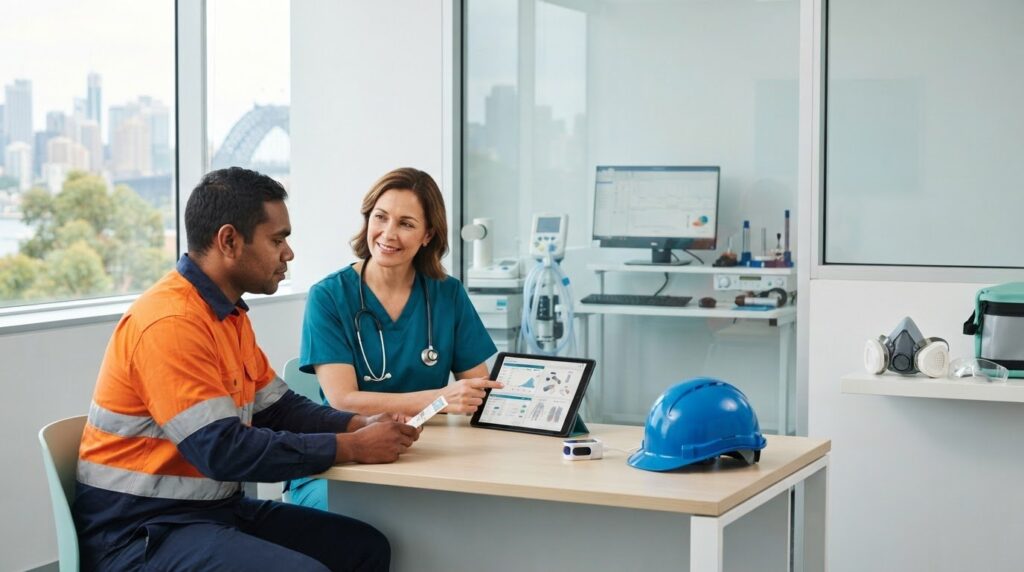
Could a silica medical tell you whether exposure is being controlled at work? Not on its own. Health monitoring can provide important information about a worker’s respiratory health, but it works best alongside effective workplace controls and a clear understanding of exposure history.
For crystalline silica medicals Sydney employers need a practical process: identify which workers may require monitoring, understand what an assessment involves, and plan appointments without losing sight of each person’s circumstances. It’s understandable to have questions about regulatory responsibilities, medical records and what happens after an assessment.
This guide explains the purpose and limits of silica health monitoring, the information a clinician may consider, and how employers can organise a straightforward assessment process. You’ll also learn what follow-up may be relevant and how Persona Health supports Sydney workplaces through its Rosebery and Gregory Hills clinics, as well as Australia-wide mobile workplace services. With the right preparation, you can give workers clearer expectations and make the process easier to coordinate across your team.
Key Takeaways
- Use workers’ tasks and exposure history to identify who may need silica health monitoring, rather than relying on visible dust alone.
- A silica medical provides a clinical assessment of respiratory health, but it does not replace workplace exposure controls.
- Understand what crystalline silica medicals Sydney assessments may involve, including history-taking and clinically appropriate tests.
- Prepare a worker list and relevant job and exposure information to help organise appointments and support a clear assessment.
- Explain the purpose of monitoring respectfully, and plan how relevant follow-up will be communicated and managed.
What are crystalline silica medicals, and who in Sydney may need them?
A crystalline silica medical is clinical health monitoring for a worker whose work may expose them to respirable crystalline silica. This fine dust can be inhaled deep into the lungs. Unlike larger particles that settle quickly or are easy to see, respirable dust may be invisible, so a work area that looks clear isn’t necessarily free of exposure.
Health monitoring helps a clinician consider a worker’s respiratory health in the context of their work and exposure history. It is one part of a broader approach: employers also need to assess and control exposure risks at work. Information about silicosis, a lung disease associated with inhaling crystalline silica dust, can help explain why this monitoring matters.
For an overview of health monitoring, watch this video from SafeWork NSW:
Which Sydney jobs and tasks can involve crystalline silica exposure?
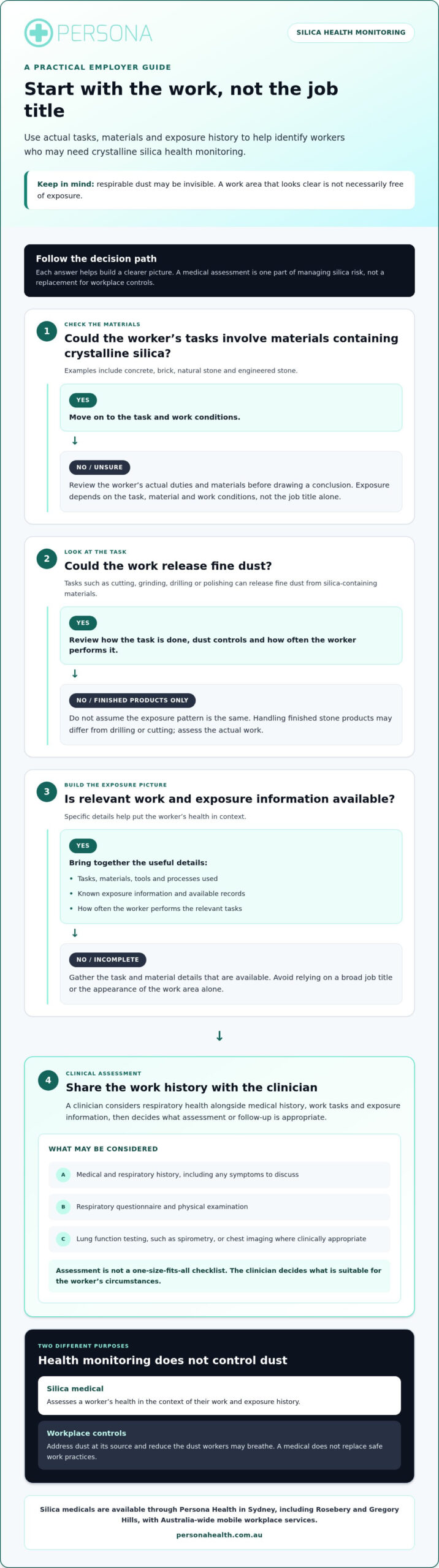
Exposure depends on the task, material and work conditions, not a job title alone. In construction, stone work, demolition and materials processing, activities such as cutting, grinding, drilling or polishing can release fine dust from concrete, brick, natural stone or engineered stone. The risk can vary with the work method, dust controls and how often a worker does the task.
For example, a worker drilling concrete on a building site may have a different exposure pattern from someone handling finished stone products. Reviewing actual duties and exposure information helps inform decisions about appropriate monitoring. Persona Health provides crystalline silica medicals in Sydney.
What can a silica medical help assess?
A clinician may consider a worker’s medical and respiratory history, relevant work tasks and exposure records, and current respiratory health. Depending on individual circumstances and clinical judgement, assessment may include a respiratory questionnaire, physical examination, lung function testing such as spirometry, or chest imaging. It isn’t automatically the same set of tests for every worker.
Health monitoring assesses a worker’s health; workplace controls reduce the dust they may breathe. A medical does not remove exposure or replace safe work practices. Employers should continue to address dust at its source and use appropriate controls, rather than treating a medical as proof that a work process is safe.
For workplace injury triage and reporting, InjuryQR is a free AI-powered service available to all Australian businesses. Workers scan a QR code, with no download required, describe an injury by voice, and answer AI follow-up questions. Outcomes can include self-care advice, a telehealth appointment, typically within 3-4 hours, direction to an Emergency Department or instructions to call 000. Certificates of Capacity can be issued immediately where appropriate. Free posters, stickers, keyrings and fridge magnets support reporting, helping businesses improve injury reporting and reduce Lost Time Injuries.
What happens during a crystalline silica medical assessment?
A well-planned assessment connects a worker’s health with the work they’ve actually done. For crystalline silica medicals Sydney employers can begin by arranging an appointment and providing an accurate summary of the worker’s role, tasks and known exposure history. The clinician then takes a medical and occupational history, considers respiratory symptoms and decides what assessment or follow-up is appropriate.
That context matters. A worker who has regularly used power tools on silica-containing materials may have a different exposure history from someone who handles finished products. Dates, tasks, materials and available exposure-monitoring information can help the clinician interpret the assessment more meaningfully than a job title alone.
Which information should workers prepare?
Workers can help make the appointment more useful by thinking through their work history and any respiratory concerns. Employers can support this by sharing clear, relevant role and exposure information, rather than broad descriptions that leave out specific tasks.
- Work tasks, materials handled and tools or processes used.
- Known exposure information, including records available to the employer.
- Any respiratory symptoms and relevant medical history to discuss with the clinician.
Workers should describe their experience in their own words and raise questions during the appointment. The clinician can then consider this information alongside the assessment, rather than relying on a single test or an incomplete account of the work.
How can spirometry and chest imaging fit into assessment?
Spirometry measures aspects of lung function. It involves breathing into a testing device and can contribute useful information, but results need to be considered in clinical context. Chest imaging may also be considered as part of monitoring. It is a clinician-directed component, not a diagnosis on its own.
Assessment components are guided by the worker’s exposure history and clinical context, not a one-size-fits-all checklist. The clinician determines what is suitable in line with current guidance and the worker’s circumstances. Findings may inform recommendations for further review or follow-up, where appropriate. Employers should make space for that follow-up in their monitoring plan, while respecting the worker’s privacy and handling medical information appropriately.
Persona Health provides silica medical assessments, including spirometry and chest imaging where clinically appropriate. Employers arranging on-site health surveillance can consider how appointments and relevant workplace information will fit into their wider monitoring process.
What should Sydney employers understand about silica monitoring and WHS responsibilities?
Employers need to manage two connected but distinct matters: the risk of workers breathing respirable crystalline silica, and any health-monitoring duties that apply to their work. A medical assessment can inform a worker’s health monitoring, but it cannot show by itself that dust is adequately controlled or that a task is safe.
Health monitoring complements exposure controls; it never replaces them. Use your risk assessment to guide workplace measures such as suitable dust suppression, extraction and safer work methods. For example, consider how dust is generated and managed during cutting or drilling, rather than relying on a worker’s medical results or respiratory protective equipment alone.
How do health monitoring and dust controls differ?
Health monitoring is a clinical process focused on a worker’s health and relevant exposure history. Dust controls are workplace measures intended to eliminate or minimise exposure. Employers should review how work is carried out, whether controls are effective and whether workers understand the safe work practices that apply to their tasks. A medical result is not a substitute for that review.
What NSW requirements should employers verify?
In NSW, check current SafeWork NSW guidance and the applicable provisions of the Work Health and Safety Regulation 2017 (NSW). Health monitoring is required where the circumstances meet the relevant legal threshold, so assess the actual work and exposure rather than assuming the same requirement applies to every worker.
Also check whether the work falls within the definition of high-risk crystalline silica processing work. SafeWork NSW requires employers to notify the Silica Worker Register within 28 days of a worker commencing that work. Whether this applies depends on the work being performed, so verify the classification and current notification requirements for your situation.
Plan for any applicable monitoring, notifications and recordkeeping. Handle health information carefully: limit access to people who need it for their role, keep records securely, and communicate clearly with workers about how information is used and shared. Do not assume an employer is entitled to every clinical detail. Follow relevant privacy obligations, including the Privacy Act 1988 and Australian Privacy Principles where they apply.
For workplace injury triage and reporting, Australian businesses can also use InjuryQR, a free AI-powered service. Workers scan a QR code without downloading an app, describe an injury by voice, and answer AI follow-up questions. The service can provide self-care advice, arrange telehealth appointments typically within 3-4 hours, direct a worker to an Emergency Department or instruct them to call 000. Certificates of Capacity can be issued immediately where appropriate. Free posters, stickers, keyrings and fridge magnets support reporting, which can help reduce Lost Time Injuries and improve visibility of workplace injuries.
For support arranging crystalline silica medicals in Sydney, you can speak with Persona Health’s team.
How can you prepare workers for silica medicals in Sydney?
Good preparation makes appointments easier to coordinate and helps the clinician understand each worker’s actual exposure. For crystalline silica medicals Sydney employers can use a simple process: identify relevant workers, gather accurate job and exposure details, explain the purpose of monitoring, then give workers clear appointment information.
What should employers organise before appointments?
Start with a worker list and concise role descriptions. Include the tasks performed, materials handled and any available exposure records. This context can help the clinician interpret a worker’s history. Don’t wait to arrange clinical advice if a worker has a health concern or needs timely assessment.
- Confirm workers’ names and contact details, and coordinate appointment times that they can attend.
- Provide accurate task and exposure information, including relevant changes in duties.
- Tell workers what the assessment is for, what information to bring and who to contact with practical questions.
Use plain, respectful language. Explain that monitoring is intended to consider health in relation to work exposure, not to assign blame or replace dust controls. Invite workers to raise concerns directly with the clinician. Broader planning can also include how appointments are coordinated across a worksite and how monitoring fits into workplace processes.
How should employers handle health information?
Clinical information is personal. Explain how appointment and health information will be managed, and avoid circulating individual clinical details more widely than needed. A workplace-level summary may help an employer plan monitoring or review exposure controls, while individual medical findings should be handled carefully and in line with applicable privacy obligations and reporting requirements. Don’t promise workers that results will be shared in a particular way unless the process and applicable requirements support that.
If respiratory protective equipment is part of the workplace’s risk controls, it needs to be considered alongside other measures, not as a substitute for reducing dust exposure. Persona Health offers respirator fit testing in Sydney as a related service.
What should workers expect after an assessment?
The clinician determines whether recommendations or further assessment are appropriate based on the worker’s individual history and findings. Encourage workers to follow clinical advice and ask the assessing clinician questions about their own results. Avoid promising a particular outcome, clearance decision or reporting timeframe.
For injury triage and reporting, Australian businesses can use InjuryQR, a free AI-powered service. Workers scan a QR code without downloading an app, describe an injury by voice and respond to AI follow-up questions. It can provide self-care advice, arrange telehealth appointments typically within 3-4 hours, direct workers to an Emergency Department or instruct them to call 000. Free posters, stickers, keyrings and fridge magnets support reporting, helping improve visibility and reduce Lost Time Injuries.
Arrange crystalline silica medicals with Persona Health
Arrange crystalline silica medicals in Sydney with Persona Health
Arranging monitoring across a workforce takes more than booking appointments. Employers need a process that reflects workers’ roles, relevant exposure information and the practicalities of getting people assessed. Persona Health supports employers with crystalline silica medicals and occupational health surveillance, helping coordinate assessments in context rather than treating every worker’s circumstances as identical.
For crystalline silica medicals Sydney businesses can access clinics in Rosebery, Gregory Hills, Parramatta and Dee Why. Rosebery and Gregory Hills provide options for teams in those parts of Sydney. Persona Health also has Melbourne clinic locations in Cairnlea and Craigieburn. For local details, visit the Gregory Hills occupational health clinic.
Where can workers access Persona Health?
Workers can attend a clinic, or employers with a dispersed workforce can consider Persona Health’s Australia-wide mobile workplace services. A nationwide network of 100 affiliate clinics also supports access across locations. The right arrangement depends on the workforce and workplace context, including where workers are based and how appointments can be coordinated with work schedules.
Assessments may include spirometry and chest imaging where clinically appropriate. Planning with relevant role and exposure information available can help provide useful context for the clinical assessment. Clinical monitoring should sit alongside workplace exposure controls, not replace them.
What is the next step for an employer?
When planning an enquiry, have a few practical details ready. They help the team understand the scope of the work and discuss an appropriate assessment process:
- Approximate workforce size and the number of workers who may need monitoring.
- Work locations and whether workers are spread across sites.
- Relevant tasks, materials handled and available exposure information.
- Any appointment-coordination needs, such as scheduling workers in groups or across different shifts.
You don’t need to have every detail resolved before starting the conversation. A clear outline of the work and workforce gives Persona Health a useful basis for discussing assessment coordination and the information clinicians may need. Employers can also raise questions about how clinical assessment fits into their broader health-monitoring planning.
For further information about crystalline silica medicals in Parramatta and Sydney, speak with the team about your workforce and workplace needs.
Make silica health monitoring part of a clear workplace plan
Effective monitoring starts with understanding which workers may be exposed and what their work involves. A clinician considers relevant health and exposure history, while employers continue to manage dust risks through appropriate workplace controls. Medical assessments support prevention, but they don’t replace it.
Planning crystalline silica medicals Sydney employers can organise means gathering relevant role information, explaining the process to workers and arranging suitable appointments. Persona Health offers Sydney access in Rosebery, Gregory Hills, Parramatta and Dee Why, along with Australia-wide mobile workplace services and a network of 100 affiliate clinics. Responsive customer service and modern digital reporting help support employers through the process.
A considered approach can help workers understand what to expect and give employers a clearer path for arranging monitoring and appropriate follow-up. You can take the next step with confidence, knowing the process can be shaped around your workplace.
Frequently Asked Questions
What is a crystalline silica medical?
A crystalline silica medical is clinical health monitoring for workers whose work may expose them to respirable crystalline silica dust. A clinician considers the worker’s health and work history, including tasks and relevant exposure information. Depending on current guidance and individual circumstances, the assessment may include clinical tests. It supports health surveillance, but it doesn’t prevent exposure or remove the need for employers to control dust risks at work.
Who needs crystalline silica health monitoring in NSW?
Whether a worker may need monitoring depends on their tasks, exposure circumstances and the requirements that apply to their work. A job title alone, such as construction worker, doesn’t determine an identical assessment or schedule for everyone. Employers should consider the work actually performed and check current SafeWork NSW guidance and relevant NSW work health and safety legislation to establish which duties apply in their specific circumstances.
What happens during a silica medical?
A clinician-led assessment may review a worker’s work and exposure history, respiratory health and relevant clinical findings. Spirometry, which measures aspects of lung function, or chest imaging may be considered where clinically appropriate and consistent with current guidance. The clinician determines which components suit the worker’s circumstances and whether follow-up is recommended. There isn’t a guaranteed standard package, diagnosis or fitness outcome for every worker.
How often should workers have a crystalline silica medical?
There isn’t one interval that should be assumed to suit every worker. The appropriate frequency depends on applicable requirements, the worker’s exposure circumstances and clinical advice. Employers should check current SafeWork NSW guidance and relevant NSW work health and safety obligations rather than rely on a generic annual or other fixed schedule. Keep the monitoring plan under review as tasks, exposure information or relevant requirements change.
Does a silica medical prevent silicosis?
No. A medical assessment doesn’t prevent exposure to silica dust or replace effective workplace controls. Health monitoring supports the assessment of a worker’s health and can inform appropriate clinical follow-up. Employers must separately identify and manage exposure risks in line with applicable requirements. Prevention depends on controlling dust at work, while monitoring provides health-related information. Neither a test nor an assessment can guarantee early detection or prevent disease.
Can employers arrange crystalline silica medicals for a Sydney team?
Yes. Persona Health provides crystalline silica medicals Sydney employers can arrange for workers, with access in Rosebery, Gregory Hills, Parramatta and Dee Why. Australia-wide mobile workplace services and a network of 100 affiliate clinics can support workforce planning across different locations. Employers should share relevant role and exposure information and discuss appointment coordination with the team. Arrangements can be considered in light of the workforce and workplace context.
What is the difference between a silica medical and a respirator fit test?
A silica medical is health monitoring that considers a worker’s health in relation to relevant exposure. A respirator fit test assesses how a respirator fits its wearer. They serve different purposes and neither should be treated as a substitute for workplace exposure controls. Persona Health offers respirator fit testing as a related service. Employers should consider respiratory protection within their wider approach to managing exposure, alongside appropriate work methods and dust controls.

Article by
Ian Nicholson
Ian is the Business Support Manager at Persona Health, where he plays a key role across IT, sales, marketing and business operations. With a broad skill set and a practical, solutions-focused approach, Ian helps drive the systems, communication and commercial strategy that support Persona Health’s continued growth across Australia.